Scaling Accurate Speaker Attribution with Hybrid Human + ML
Learn about Speaker Attribution at Scale: Hybrid Human+ML Workflows to Ensure Accurate Transcript Speaker Labels in this comprehensive SEO guide.
Introduction
Accurate speaker attribution — assigning the correct speaker label to each segment in a transcript — is critical for searchable records, compliant transcripts, analytics, and personalized experiences. For business professionals managing high volumes of meetings, calls, and media, naive transcript pipelines that rely solely on automatic diarization or manual labeling either deliver inconsistent accuracy or lack scalability. This article explains how hybrid human+ML workflows solve that tradeoff and provides an implementation blueprint and operational guidance for scaling accurate speaker labels across your organization.
Why speaker attribution at scale matters for business
Poor speaker attribution can undermine analytics, create compliance risk, reduce the value of search and knowledge extraction, and create bad user experiences in downstream apps (e.g., meeting summaries, CRM updates).
- Regulatory and legal contexts require clear speaker identification for transcripts used in compliance or litigation.
- Sales and support teams need reliable speaker labels to associate commentary with individual accounts or agents.
- Analytics and AI downstream (sentiment, summary, action items) depend on correct speaker segmentation for quality insights.
What is a hybrid human+ML workflow?
A hybrid human+ML workflow pairs automated systems (ASR, diarization, speaker embeddings, clustering) with targeted human review to resolve ambiguity and correct errors. The goal is to allocate human effort where it yields the biggest accuracy improvement, while automation handles high-confidence segments.
Core components of a scalable pipeline
1. Automated diarization and timestamping
Use an ML diarization engine to segment audio into speaker-homogeneous intervals and assign tentative speaker IDs with timestamps. Modern diarizers produce speaker change points and candidate speaker turns quickly, forming the foundation for labeling.
2. Speaker embeddings and clustering
Create per-segment speaker embeddings (d-vectors, x-vectors) that capture voice characteristics independent of spoken words. Cluster embeddings to group segments by likely speaker identity across a conversation or corpus.
3. Confidence scoring and triage
Compute confidence at multiple levels: diarization boundary confidence, embedding cluster purity, ASR word-level confidence, and downstream label assignment confidence. Use thresholds to auto-accept, flag for review, or reject. Confidence-driven triage is the primary lever for scaling.
4. Human-in-the-loop verification and correction
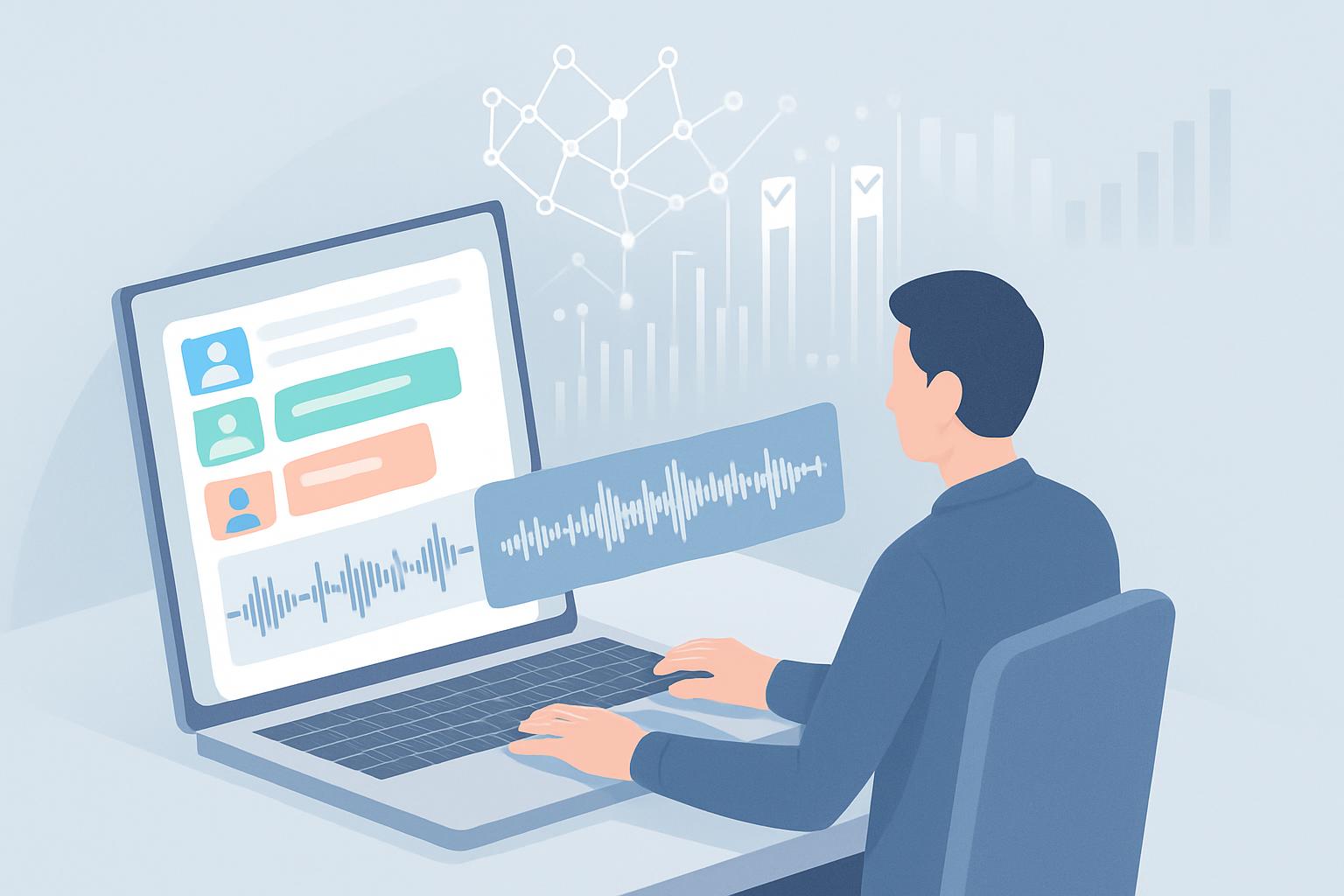
Route low-confidence segments or mismatches (e.g., speaker count disagreement with metadata) to human annotators via an efficient UI that shows audio, waveform, context, and proposed labels. Allow quick actions: accept, merge clusters, split clusters, reassign label, or mark as 'unknown'.
Designing the workflow: step-by-step
Step 1 — Ingest and pre-process
- Normalize audio (sample rate, noise reduction). 2) Extract channel metadata (multi-channel vs mono). 3) If available, attach contextual metadata (meeting roster, agent IDs, call participants) that can seed labeling.
Step 2 — Automated analysis
- Run ASR to generate transcript and timestamps. 2) Run diarization to propose speaker segments. 3) Extract speaker embeddings for each segment and perform clustering.
Step 3 — Scoring and rule-based triage
- Compute combined confidence score per segment or cluster. 2) Apply business rules (e.g., enforce minimum and maximum speaker counts, tie to roster data). 3) Auto-accept high-confidence labels and place the rest into the review queue.
Step 4 — Human review and corrections
Design a reviewer interface optimized for speed: synchronized audio waveform, jump-to-segment, quick-label buttons, context view of adjacent segments, and access to participant metadata. Capture structured corrections (merge/split/relabel) and qualitative feedback when necessary.
Step 5 — Feedback loops and continuous improvement
Use human corrections to: 1) retrain diarization thresholds and clustering parameters, 2) fine-tune speaker identification models (where identifiable), and 3) recalibrate confidence scoring. Automate periodic model retraining and A/B validation tests so the system improves with use.
Operational patterns for scale
Scaling hybrid workflows requires orchestration, staffing, and governance:
- Batch vs streaming: Decide whether transcripts need near-real-time speaker labels (streaming) or can be processed in batches; streaming requires lightweight triage and potentially fewer human interventions.
- Reviewer pool: Use a mix of in-house SME reviewers for sensitive content and outsourced annotation vendors for volume; enforce consistent QA rules and performance SLAs.
- Routing logic: Prioritize high-value content for human review (e.g., top customers, regulatory calls) and apply automation to low-value or repeatable content.
- Throughput planning: Model expected hours of audio per day and set reviewer headcount and automation thresholds to meet SLAs.
Sign up for our newsletter
Get the latest updates, product launches, and helpful tips delivered straight to your inbox.
Metrics and KPIs to monitor
Track a focused set of metrics to evaluate effectiveness and ROI:
- Speaker Label Accuracy (SLA): percentage of speaker-attributed segments that match ground truth.
- Diarization Error Rate (DER): standard metric combining missed speech, false alarms, and speaker confusion (see NIST evaluations).
- Human Review Rate: percent of segments routed to human reviewers.
- Correction Time per Segment: average human minutes to fix a labeled segment.
- Automation Acceptance Rate: percent of auto-assigned labels accepted without change.
- Model Improvement Rate: reduction in error metrics after retraining cycles.
Implementation checklist (practical)
- Define success metrics (SLA targets for accuracy and throughput).
- Choose baseline ML components (ASR, diarizer, embedding extractor) — evaluate on representative audio.
- Design confidence scoring and triage rules with business stakeholders.
- Build a lightweight reviewer UI tailored for quick speaker corrections.
- Instrument logging for reviewer actions and model inputs/outputs for retraining.
- Create QA and auditing processes, including periodic blind review and inter-annotator agreement checks.
- Plan governance: data privacy, PII handling, and access controls for audio and labels.
Contextual background: diarization, embeddings, and labeling explained
Understanding the technology behind speaker attribution helps make informed design decisions.
Diarization fundamentals
Diarization segments audio by speaker-change points and produces speaker-homogeneous intervals. Popular approaches combine acoustic change detection, clustering, and probabilistic models. Diarization struggles with overlaps, short segments, and low-SNR audio.
Speaker embeddings
Embeddings convert short audio snippets into fixed-length vectors representing vocal characteristics. Clustering these vectors helps group segments by speaker identity across a conversation. Embeddings are robust to content variation but can be confounded by channel effects.
Why pure ML can fail at scale
ML-only systems are sensitive to domain shift (phone vs. meeting audio), novel speakers, background noise, and overlapping speech. Without human intervention, errors compound across transcripts and downstream analytics.
Key Takeaways
- Hybrid human+ML workflows balance scalability and accuracy by routing only low-confidence cases to people.
- Confidence scoring, speaker embeddings, and targeted review interfaces are the highest-impact levers.
- Instrumenting feedback loops and retraining on corrected labels reduces long-term human effort and error rates.
- Measure DER, Speaker Label Accuracy, and Human Review Rate to evaluate success and optimize thresholds.
- Prioritize privacy, governance, and QA processes when implementing at enterprise scale.
Frequently Asked Questions
How much human review is typically required when using a hybrid approach?
It depends on audio quality and system maturity. A well-tuned hybrid pipeline can reduce human review to 10–40% of segments (higher if audio is noisy or speakers overlap frequently); start conservatively and lower review rates as models retrain on corrected data.
What confidence thresholds should I use to auto-accept labels?
There is no one-size-fits-all threshold; calibrate thresholds using a validation set and choose targets for acceptable false-accept and false-reject rates based on business risk. Common practice is to auto-accept labels with >0.9 combined confidence and triage those below 0.7, with manual review for the mid-range.
Can speaker attribution be done in real time for live meetings?
Yes, streaming diarization and real-time embeddings enable live speaker attribution, but they typically sacrifice some accuracy for latency. Implement a hybrid strategy where streaming auto-labels the bulk of content and a post-meeting batch pass plus human review refines labels.
How do you handle unknown speakers or large participant rosters?
For unknown speakers, label as 'Speaker 1/2/...' with cluster IDs and allow human reviewers to map cluster IDs to identities (when identity metadata exists). For large rosters, use roster constraints and speaker enrollment where available to anchor labels automatically.
What are common failure modes and how do I mitigate them?
Common failures: overlapping speech, channel bleed, short utterances, and domain mismatch. Mitigations include improved pre-processing (noise suppression), multi-channel separation, stricter confidence thresholds for short segments, and domain-specific retraining.
How should we manage privacy and compliance in hybrid workflows?
Implement role-based access controls for audio and transcripts, apply PII redaction before human review when required, log reviewer access, and store only the minimum metadata needed for labeling. Ensure vendors comply with relevant regulations (e.g., GDPR, HIPAA) where applicable.
Sources: NIST Rich Transcription and diarization evaluations, public documentation from major cloud providers on diarization and speaker identification, and industry best practices from transcription and annotation vendors.
(Example references: NIST evaluations; vendor docs such as Google Cloud Speech-to-Text and AWS Transcribe for diarization features.)
Sign up for our newsletter
Get the latest updates, product launches, and helpful tips delivered straight to your inbox.
Scheduler
Hand your calendar to an assistant that never drops a thread.
Keep reading

AI Notetakers Are Sitting In on More Meetings Than You Think, Often Without Asking
One in three employed Americans say an AI notetaker has been in their work meetings, and 65% of them say they weren't consistently asked first, according to a July 2026 survey. Here's what that consent gap actually means for teams and legal risk.
![Privacy‑Safe Personal Appointments: Expert Guide [Proven]](https://nuxxt0us9k7umi1n.public.blob.vercel-storage.com/blog-covers/6a4ebc1188d93a9e734f50e2_article-28df6357-c673-43f7-8598-4df42e844f3e.jpeg)
Privacy‑Safe Personal Appointments: Expert Guide [Proven]
Enable Privacy‑Safe Personal Appointments: Let an Assistant Book Health or Family Slots Without Revealing Details —Proven controls. Read expert analysis

Measuring the Business Impact of Recorded Meetings: KPIs for
Learn about KPIs for Recorded Meetings: Measuring Impact on Deal Velocity, Onboarding Speed, and Decision Quality in this comprehensive SEO guide.