AI Agents for Grocery Store Chains: Why the Real Automation Fight Is at the Self-Checkout Lane
68% of U.S. food retailers now use AI, up from 47% a year ago, per FMI's own 2026 industry survey. But the sharpest near-term AI fight in grocery isn't in the supply chain, it's at the self-checkout lane, where shoplifting, false alarms, and employee abuse are colliding.
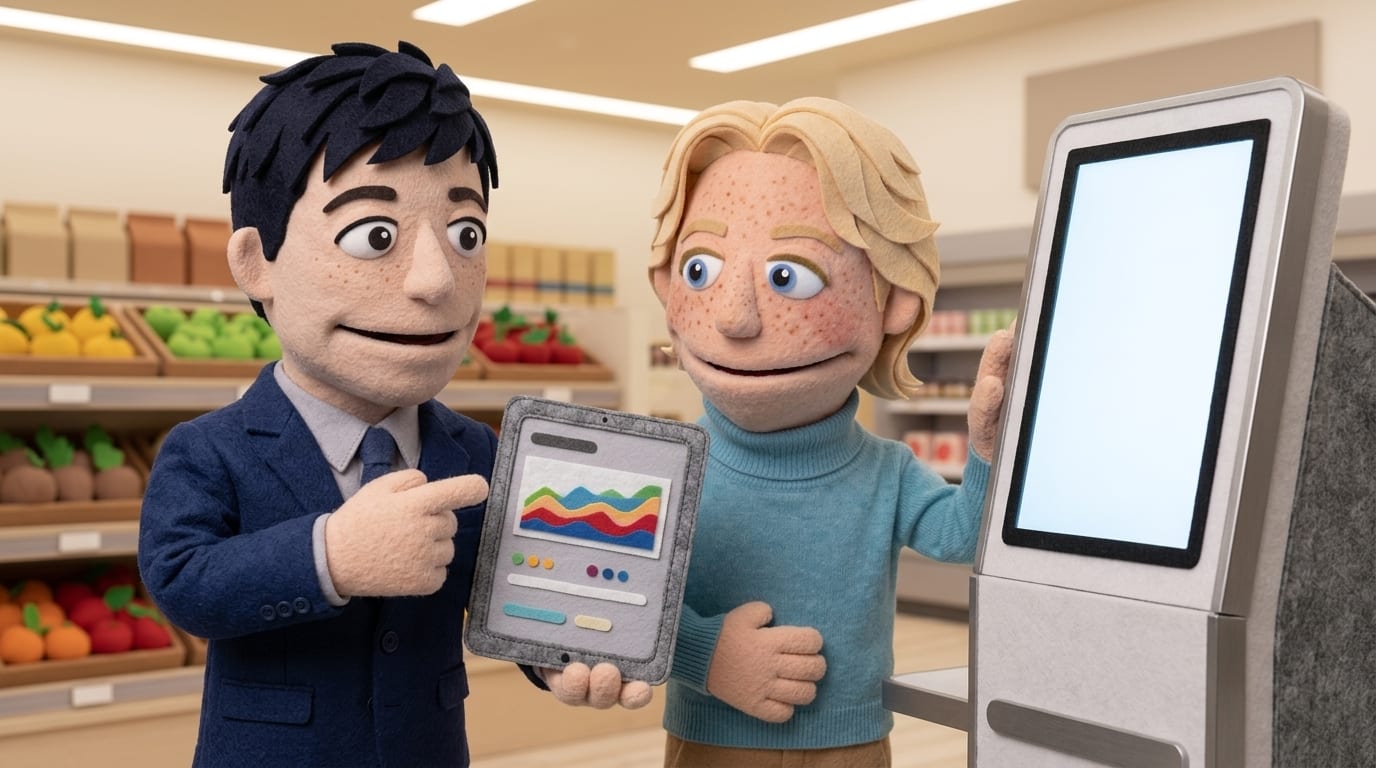
Ask a grocery executive where AI is paying off right now, and the supply chain is usually the first answer — demand forecasting, replenishment, markdown optimization. That story is real, but it's not where the most urgent AI deployment decision in grocery is actually happening in 2026. That's happening a few feet from the front door, at the self-checkout lane.
The adoption numbers are real, and they're moving fast
FMI — The Food Industry Association's The Food Retailing Industry Speaks 2026 report, released July 7, 2026 and based on a survey of 70 food retail and wholesale companies representing over 42,000 stores (supplemented with data from eight public companies' SEC filings), found that food retailers are now implementing AI for operational tasks including assortment planning and loss prevention. Suppliers are outspending retailers on the shift: suppliers put 3.3% of sales into technology in 2025, versus 1.9% for retailers, and 83% of suppliers expect to increase that investment again in 2026.
That's happening against a backdrop of thin margins — food retail profit margins sat at just 2.1% in 2025, per the same FMI report, with roughly 11% of food retailers posting outright losses. Eighty-two percent of food retailers surveyed said they're experimenting with in-store technologies specifically to improve the customer experience, and credit and debit cards now make up 81% of all sales, a new high that's reshaping what "friction" even means at checkout.
Self-checkout is where the AI case gets concrete
A separate industry survey — British retail-tech firm VoCoVo's research, covering 250 U.S. retail food decision-makers and 500 consumers, published August 2026 — makes the self-checkout problem specific. Nearly 59% of grocery retailers surveyed said the introduction of self-checkout had increased shoplifting; among food retailers broadly, the figure climbed to 61.9%.
That's turned AI from a nice-to-have into an operating necessity for a lot of chains. According to VoCoVo's data, 41.2% of grocery retailers are already integrating AI into anti-theft operations at self-checkout, and another 44.1% of those who haven't yet say they intend to launch AI-based anti-theft tools within the next 12 months. Taken together, that's roughly 85% of the category either live or committed within a year — a faster near-term commitment curve than almost any other grocery use case.
Grocers aren't just chasing shrink, either. The same survey found 46.7% of respondents are prioritizing smart shelves and inventory sensors, and 30% are looking at automated incident alerts — both framed as the data layer that AI-powered store alerts and staff coordination depend on.
The part that doesn't make the AI pitch deck: employee abuse
The VoCoVo numbers also surface a less-discussed driver behind AI's current grocery momentum: frontline employee safety. 79.4% of grocery retailers surveyed said they're concerned about verbal and physical abuse directed at employees, and the survey put the average at 58.7 hostile incidents per employee per year — close to one a week. 32.4% of retailers said employees had resigned in the prior 12 months specifically because of customer abuse.
That's a retention problem layered on top of a shrink problem, and it's part of why 88.2% of grocery retailers surveyed believe AI will play an important role in reducing workplace abuse over the next year. The pitch isn't "AI replaces staff" here — it's "AI gives already-stretched staff a tool that de-escalates before an incident becomes a resignation."
Where AI still can't paper over a staffing gap
The same survey is a useful reality check against over-claiming. Asked what would most improve productivity, 40% of grocery retailers pointed to better product and system training — not more automation — and 35% cited simply having more employees available during peak periods. AI is being adopted fast, but grocers themselves don't think it's a substitute for having enough trained people on the floor.
FMI's own data backs that caution up from a different angle: only about 10% of surveyed retailers believe the AI systems they're adopting will let them reassign staff. The dominant framing in grocery right now isn't headcount reduction — it's giving an already-lean floor team a tool for a specific, measurable problem: catching the right thing at the self-checkout lane without creating more friction, false alarms, or confrontations than it prevents.
What this means for grocery operators going forward
The grocers moving fastest on AI in 2026 aren't necessarily the ones with the biggest supply-chain automation budget — they're the ones treating self-checkout loss prevention and employee-safety alerting as the proving ground. Getting that use case right, where the volume of transactions is high and the cost of a false alarm is immediate and visible to a shopper, is likely to be the template chains reach for next when they decide where AI earns the right to expand into other parts of the store.
FAQ
Is AI actually reducing shoplifting at self-checkout, or just getting adopted because retailers are worried about it? Both are true at once. The adoption numbers (41.2% live, another 44.1% planning within a year) reflect genuine investment, but the industry's own survey data shows retailers are still measuring success partly by whether it reduces false alarms and friction, not just by catch rates — the systems are new enough that the ROI case is still being built in real time.
Does more grocery AI mean fewer grocery store jobs? The data doesn't support that framing yet. FMI found only about 10% of retailers expect AI to let them reassign staff, and grocers themselves ranked more staffing and better training above AI adoption when asked what would most improve productivity.
Workmate
See what an agent team would do for your business.
Keep reading
AI Agents for Equipment Rental Companies: Inside United Rentals' Push to Put an AI Agent in Every Customer's Pocket
United Rentals says its new Equipment Agent delivers a 70% improvement in customers finding the right machine, and it just became the first equipment rental app inside the ChatGPT store. Here's what that signals for an $83.5 billion industry still built on counter staff and catalogs.
AI Agents for Grocery and Supermarket Chains: What FMI's 2026 Data Says Is Actually Slowing Adoption Down
FMI's 2026 State of Technology report finds grocery AI adoption has gone mainstream (68%, up from 47%), but fewer than a third of food retailers have a defined change-management plan for it. Here's where AI agents are actually landing on the shelf, and why the investment isn't fully paying off yet.

Can Credit Unions Compete With Big Banks on AI Agents?
Credit unions are now more likely than big banks to deploy generative AI (59% vs. 49%) and twice as likely to invest in agentic AI, per Cornerstone Advisors' 2026 Banking Outlook. Here's how member-owned institutions are using AI agents to compete on service without big-bank budgets.