AI Agents for Manufacturing Teams: From GenAI Pilots to the Shop Floor
87% of manufacturers have already launched a GenAI pilot, per Deloitte's own Future of Manufacturing study, but only 10% have scaled it network-wide. Here's where AI agents are actually landing on the shop floor right now, and where the pilot-to-scale gap still is.
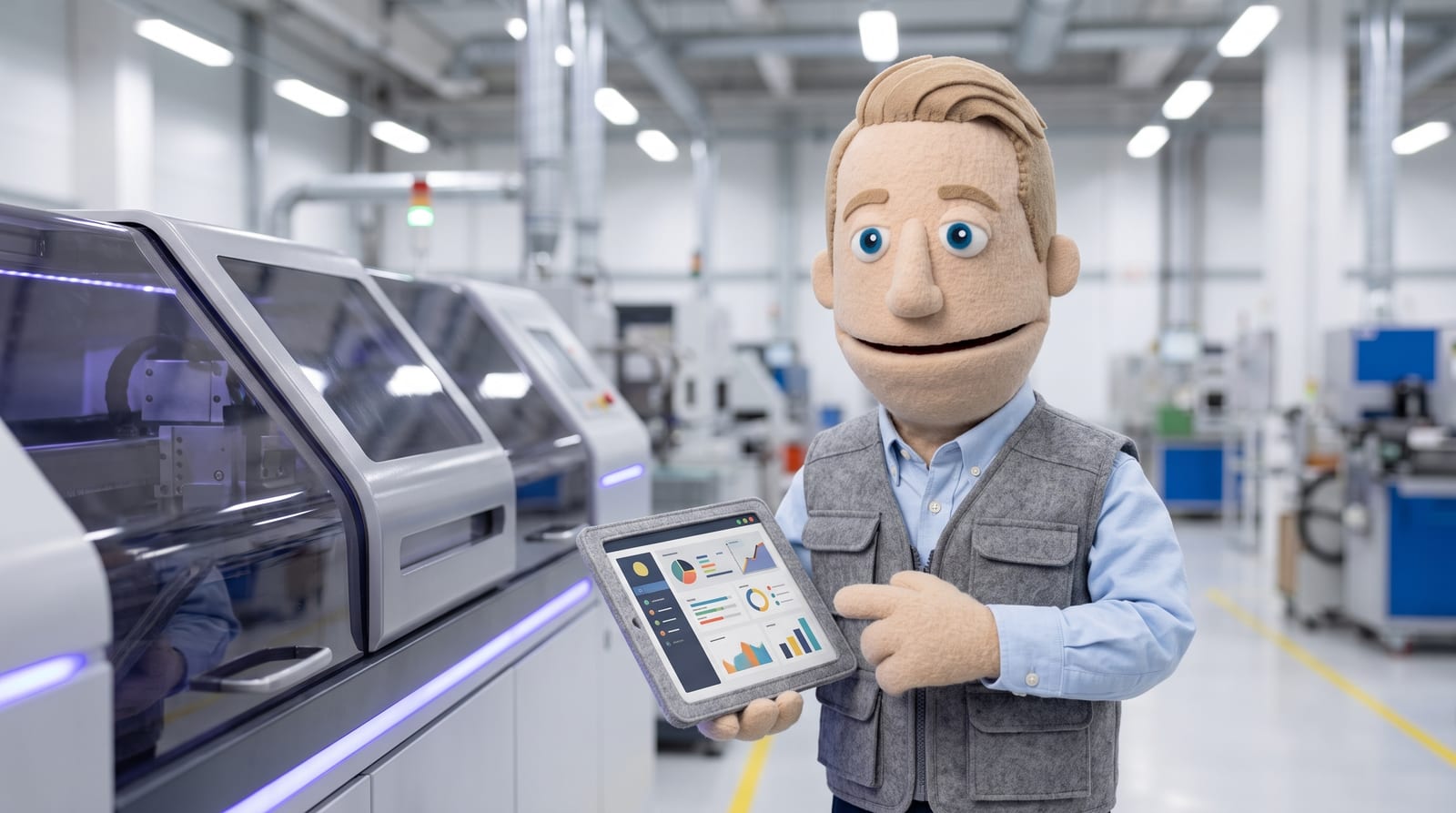
Manufacturing has a reputation for moving carefully on new technology, and for good reason: a bad software rollout on a live production line costs a lot more than a bad rollout in a back office. So it's notable that, per Deloitte's own Future of Manufacturing study, 87% of the nearly 600 manufacturers surveyed had already launched a generative AI pilot. The caution hasn't gone away — it's just moved from "should we try this" to "how far do we actually scale it."
That gap between piloting and scaling is the real story in manufacturing right now, and it's exactly where AI agents are starting to show up.
Where manufacturers actually are today
Deloitte's separate 2025 Smart Manufacturing and Operations Survey of 600 manufacturing executives puts real numbers on the pilot-to-scale gap. At the facility or network level, 29% of manufacturers are already using AI/machine learning and 24% have deployed generative AI at that same scale — but a much larger group is still in the experimentation phase: 23% are piloting AI/ML and 38% are piloting generative AI specifically. In other words, more manufacturers are still testing generative AI than are running it anywhere at scale.
Back in the Future of Manufacturing study, only 24% of respondents had adopted a GenAI use case in at least one facility, and just 10% had rolled it out across their broader network. Half of respondents still rank GenAI among their top-priority technologies to implement over the next 24 months — ahead of digital twins, the omniverse, and the metaverse, per Deloitte's own framing — which tells you the appetite is there even where the deployment isn't yet.
A newer Deloitte survey of manufacturers in Switzerland, "AI in Manufacturing 2026," found a similar pattern on a broader canvas: 84% of respondents already report measurable value from AI, but only about 20% of use cases have actually been scaled. Interestingly, that survey also breaks out what kind of AI manufacturers are actually running — machine learning and deep learning account for 42% of deployed technology, and generative AI plus agentic AI together account for 40%, meaning agent-style systems are no longer a rounding error in the mix.
What agents are actually doing on the floor
The Deloitte research is specific about where generative AI and, increasingly, agentic systems are landing inside a manufacturing operation, and it's less about replacing people on the line and more about closing information gaps:
- Shop-floor troubleshooting. Instead of waiting for a tenured operator to walk over, workers can ask a conversational assistant to diagnose an error code, pulling from sensor readings, maintenance logs, and technician reports at once.
- Knowledge capture and training. Standard operating procedures, manuals, and the tacit knowledge of experienced technicians get turned into something a newer hire can query directly, instead of sitting in someone's head or a binder on a shelf.
- Multimodal maintenance input. A worker can describe a problem by text, photo of a malfunctioning part, or audio note, and get back a diagnosis that draws on all of it together — genuinely useful on a factory floor where stopping to type a detailed report isn't realistic.
- Production and inventory monitoring. Operators and managers are using conversational interfaces to track production in real time and get help running root-cause analysis on exception-based incidents, rather than digging through dashboards themselves.
None of this requires a fully autonomous agent making unsupervised decisions on a $2 million piece of equipment, which is exactly why manufacturers are comfortable moving faster here than in some other industries — the agent is doing research and synthesis, and a human is still making the call.
Sign up for our newsletter
Get the latest updates, product launches, and helpful tips delivered straight to your inbox.
Why the scaling gap persists
Deloitte points to a few concrete reasons manufacturers stall between pilot and scale, and none of them are really about the AI model itself. Data privacy and security top the list — manufacturers are wary of feeding proprietary process data into public models, which is why the report recommends zero-retention policies with vendors and tight internal access controls as table stakes, not optional extras. Model "hallucination" risk is the second concern, particularly because a wrong answer about a safety procedure or equipment fault carries real physical consequences, not just an embarrassing typo.
The fix Deloitte recommends isn't slowing down further — it's building the same kind of quality-assurance discipline manufacturers already apply to physical processes: a dedicated GenAI quality assurance function, continuous evaluation against bias/accuracy/coherence benchmarks, and starting with narrow, high-value use cases rather than trying to automate an entire function at once.
What this means for manufacturing teams going forward
The manufacturers pulling ahead aren't the ones chasing the flashiest agentic AI pilot — they're the ones treating data readiness as the actual bottleneck. Deloitte's own data backs this up: manufacturers investing first in sensors, cloud computing, and data standards are the same ones further along in scaled AI/ML deployment, because an agent is only as good as the operational data it can actually see.
If you're evaluating where to start, the pattern across all three Deloitte surveys points to the same answer: pick one narrow, well-bounded problem — a maintenance chatbot, a shift-handoff summarizer, an exception-monitoring assistant — get it into a real facility, and only then think about network-wide rollout. The 87% who already have a pilot running have proven the appetite is real. The 10% who've scaled it are proving it's possible. The work between those two numbers is where the next few years of manufacturing AI will actually get decided.
Sign up for our newsletter
Get the latest updates, product launches, and helpful tips delivered straight to your inbox.
Workmate
See what an agent team would do for your business.
Keep reading

AI Agents for Beauty and Wellness Businesses: What a New European Benchmark Reveals About the Booking Gap
Zenoti's first European Beauty and Wellness Benchmark Report finds new client visits falling across salons, spas, and clinics — while AI-powered booking tools are linked to roughly £76,764 a year in extra revenue per top-performing location.
AI Agents for Moving and Relocation Companies: Why the Industry's Labor Crunch Keeps Pointing Back to the Office
A 12% projected driver and crew shortfall through 2028 is pushing moving companies toward AI-assisted paperwork, translation, and dispatch. Elromco's 2026 industry report shows which digital tools are actually cutting turnover and admin time.
AI Agents for Trust & Safety Teams: Why Automating the Easy Decisions Is Making the Hard Ones Harder
97% of content-moderation detections are already automated, per EU DSA filings. But PwC's 2026 Trust and Safety Outlook finds 85% of leaders say new AI-driven harms are emerging faster than teams can respond — here's what's actually changing.