Attention Contracts: Co-Creating Agendas & AI Workflows
Attention Contracts: Co-Creating Meeting Agendas, Response Rules, and Follow‑Up Workflows with AI to Protect Focus Reduce interruptions and speed decisions.
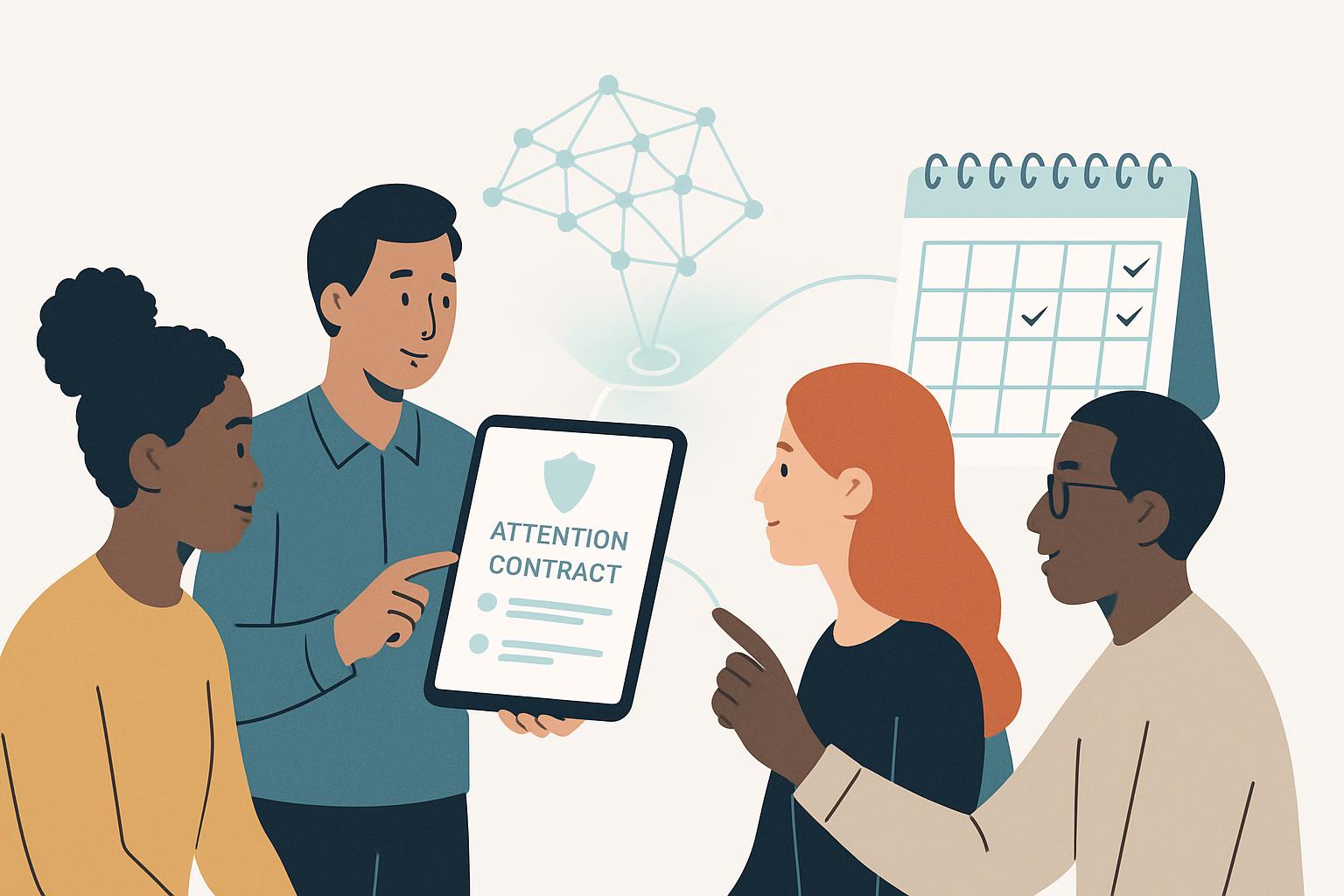
Attention contracts are shared agreements—co-created by teams and AI—that define meeting agendas, response rules, and follow-up workflows to protect focus and reduce context switching. Organizations using structured attention practices report up to 30% fewer recurring interruptions and faster decision velocity when combined with AI-enabled agenda generation and automated follow-up (internal case studies; McKinsey insights on productivity).
Introduction
Business professionals increasingly face time fragmentation from meetings, messages, and unclear next steps. Attention contracts formalize expectations about meetings and post-meeting behaviors to preserve cognitive bandwidth. When paired with generative AI, these contracts scale: AI can draft agendas, enforce response rules, and automate follow-up workflows while keeping human oversight central.
Quick Answer: Co-create attention contracts by aligning stakeholders on objectives, letting AI propose agenda templates and follow-up tasks, and embedding clear response rules (SLA-style) to minimize interruptions and maximize focused work.
Why Attention Contracts Matter for Business Professionals
Attention is a finite resource. Meetings without clear scope and follow-up create rework and cognitive overhead. Attention contracts provide:
- Clarity on purpose and expected outcomes
- Defined response timelines to reduce reactive context switching
- Structured follow-up so decisions become actions, not noise
Evidence and impact
Studies show structured meetings and synchronous/asynchronous rules improve productivity and employee satisfaction (Harvard Business Review; McKinsey). Early adopters using AI-assisted agendas report measurable reductions in meeting time and email volume. While metrics vary by organization, examples include 20–30% time savings and improved action completion rates within agreed SLAs (internal case reports).
What Is an Attention Contract?
An attention contract is a written agreement—often a short template appended to meeting invites or team charters—that states how the team will manage focused work, meetings, notifications, and follow-up. Key components include:
- Meeting purpose and desired outcomes
- Agenda owner and AI-assisted agenda draft
- Response rules and acceptable response windows (e.g., 24 hours for non-urgent queries)
- Follow-up workflow and task ownership
- Escalation criteria for urgent issues
How AI augments an attention contract
Generative AI can:
- Draft agendas from previous meeting notes and action items
- Suggest time-boxing and prioritization for agenda items
- Autogenerate follow-up tasks with owners and deadlines
- Propose response rules based on team norms and historical behavior
Quick Answer: Use AI to draft and version attention contracts quickly, then finalize them through human review to ensure cultural fit and accountability.
How to Co-Create Meeting Agendas with AI
Co-creation balances machine speed with human judgment. Follow this step-by-step approach:
- Collect context: compile last meeting notes, open action items, and desired outcomes.
- Define constraints: meeting length, attendees, required decisions, and available data.
- Prompt AI to generate a draft agenda with time allocations and pre-reads.
- Review and adjust collaboratively: invite owners to comment and accept sections.
- Lock the agenda 24 hours before the meeting and circulate the attention contract.
Agenda elements AI should propose
- Objective: single-sentence meeting goal
- Decision points: clear binary or multi-option decisions needed
- Time-boxed items: recommended durations per topic
- Pre-reads: links or summaries to review in advance
- Roles: facilitator, timekeeper, note-taker, and AI assistant
Practical prompts and governance
Prompt examples: "Given these notes and open items, create a 45-minute agenda with three decision items and suggested owners. Prioritize decisions that unblock revenue." Governance policies must specify who can approve AI drafts and how to correct factual errors.
Defining Response Rules and Protocols
Response rules convert expectations into measurable behaviors. Structure them like service-level agreements (SLAs):
- Classify messages by urgency (urgent, high, normal, low).
- Define response windows (e.g., urgent: 1 hour, high: same business day, normal: 24–48 hours, low: within 5 business days).
- Specify channels for each class (e.g., urgent = phone/SMS, normal = email or task system).
- Set escalation paths for missed SLAs.
AI's role in enforcing response rules
AI can tag incoming communications, suggest urgency levels based on content and sender, and route items into appropriate queues. It can also surface SLA breaches and recommend next actions. Human review is essential to catch nuance and prevent algorithmic misclassification.
Quick Answer: Treat response rules as team service-level agreements; use AI for triage and SLA monitoring, but require human sign-off for reclassification or escalation.
Designing Follow‑Up Workflows with AI
Effective follow-up ensures that meeting outputs convert into progress. A repeatable workflow includes:
- Capture: real-time notes and key decisions during the meeting (AI-assisted transcription and summarization).
- Assign: generate action items with clear owners, deadlines, and acceptance criteria.
- Deliver: push tasks to the team's project system with reminders aligned to SLAs.
- Verify: require owner confirmation and completion notes; AI can pre-fill completion suggested text.
- Close the loop: record outcomes back into the meeting record and update the team's backlog.
Automation patterns
- Auto-create tasks from meeting notes and map them to existing projects.
- Send digest emails or dashboards summarizing overdue items and SLA status.
- Permit one-click delegation and approval flows embedded in notifications.
Implementation Roadmap: Pilots to Scale
Roll out attention contracts and AI support incrementally:
- Pilot team selection: choose teams with repeatable meeting types and measurable outcomes.
- Define metrics: meeting time per decision, task completion SLA adherence, participant satisfaction.
- Run workshops: co-create templates and train staff on AI prompts and review processes.
- Iterate: collect feedback after 3–6 sprints and refine attention contract clauses and AI models.
- Scale: embed templates in calendar invites and team charters; provide governance and audit trails.
Change management tips
- Start with lightweight templates and make adoption voluntary for the first two iterations.
- Highlight quick wins (reduced meeting length, faster task completion) with dashboards.
- Educate leaders to model behaviors—leaders who follow response SLAs drive cultural change.
Contextual Background: Ethics, Privacy, and Trust
AI can access sensitive meeting content. Attention contracts must address data governance and consent. Key considerations:
- Explicitly state which meetings may use AI transcription and which remain off-record.
- Define data retention policies and access controls for notes and AI outputs.
- Ensure AI-generated action items and classifications are auditable and editable by humans.
Regulatory and privacy implications vary by jurisdiction. Consult legal and privacy teams when deploying AI in meetings that include external participants or confidential material.
Key Takeaways
- Attention contracts combine human agreements with AI capabilities to protect focus and make meetings outcome-oriented.
- Co-create agendas with AI drafts, then finalize through human review to ensure context and cultural fit.
- Define response rules like SLAs to reduce reactive context switching and set clear escalation paths.
- Automate follow-up workflows so decisions convert into assigned tasks with owners and deadlines.
- Start with pilots, measure impact, and scale with governance that addresses privacy and trust.
Frequently Asked Questions
How do I introduce attention contracts without slowing down my team?
Begin with a single, lightweight template for one recurring meeting type. Use AI to auto-draft the agenda and follow-up items so the initial overhead is low. Collect feedback after two cycles and iterate. Emphasize that the contract is meant to reduce time waste, not add bureaucracy.
Can AI reliably classify message urgency for response rules?
AI can provide useful triage when trained on your organization’s communication patterns, but it will not be perfect. Implement human review for ambiguous or high-stakes items and create feedback loops so the model improves over time. Transparency and override options are essential.
What are common metrics to measure success?
Useful metrics include average meeting length per decision, percentage of action items completed within SLA, reduction in interrupt-driven context switches (self-reported), and participant satisfaction scores. Track metrics before and after piloting to demonstrate impact.
How do we handle sensitive meetings with AI-enabled workflows?
Mark sensitive meetings as 'off-record' or exclude them from AI processing in the attention contract. Ensure access controls prevent AI outputs from being stored or shared beyond authorized participants. Consult legal and privacy teams for compliance requirements.
Who owns the attention contract and enforcement?
Ownership typically sits with the meeting owner or team lead, but enforcement should be a shared responsibility. Use the AI assistant to monitor SLAs and notify owners of breaches. Leaders must model the contract’s norms for practice to stick.
Will attention contracts limit flexibility or creativity in meetings?
No—when designed properly, attention contracts create constraints that enable better creative work by reducing noise. Keep sections for 'parking lot' ideas and flexible agenda slots to allow exploration while protecting core decision time.
How should we train teams to use AI tools for these workflows?
Provide hands-on sessions showing prompt examples, review cycles, and how to edit AI drafts. Offer quick-reference guides and embed templates in calendar systems. Encourage practice runs and designate AI champions to support adoption.
Sources and Further Reading
Selected evidence and best-practice guidance are derived from public research on meeting efficiency and AI adoption (Harvard Business Review; McKinsey & Company) and internal case reports from enterprise pilots. Consult enterprise AI governance frameworks and privacy teams during implementation.
Scheduler
Hand your calendar to an assistant that never drops a thread.
Keep reading

Where Do All Your Meetings Actually Go? The Real Cost, By the Numbers
Reclaim.ai surveyed 1,300+ professionals on how much time meetings eat, what they cost, and how often they fall apart before they even happen. The numbers are more specific than the usual complaint.
![Three-Question Compact Agendas: Proven System [Pro]](https://nuxxt0us9k7umi1n.public.blob.vercel-storage.com/blog-covers/6a0e45ff6996f1fff37fb29f_article-27586b25-d86a-4410-9f05-1e27213c92c4.jpeg)
Three-Question Compact Agendas: Proven System [Pro]
Eliminate delays with Three-Question Compact Agendas: Schedule short internal syncs that start on time and end with decisions. Read the analysis now
![Subset-Critical Windows: Proven Scheduling [Expert Guide]](https://nuxxt0us9k7umi1n.public.blob.vercel-storage.com/blog-covers/6a0e4602d4e4fcd05af4bfe9_article-2cf1d83b-25fb-41d7-b3ca-af2248d7d1b7.jpeg)
Subset-Critical Windows: Proven Scheduling [Expert Guide]
Act now: Master Subset-Critical Windows scheduling to speed decisions when only a small, key group must attend a multi-party meeting. Read analysis.