Building Privacy-Preserving Calendar Data Pipelines for Sche
Learn about Privacy‑Preserving Calendar Data Pipelines: How to Train Scheduling AI without Exposing Sensitive Meetings in this comprehensive SEO guide.
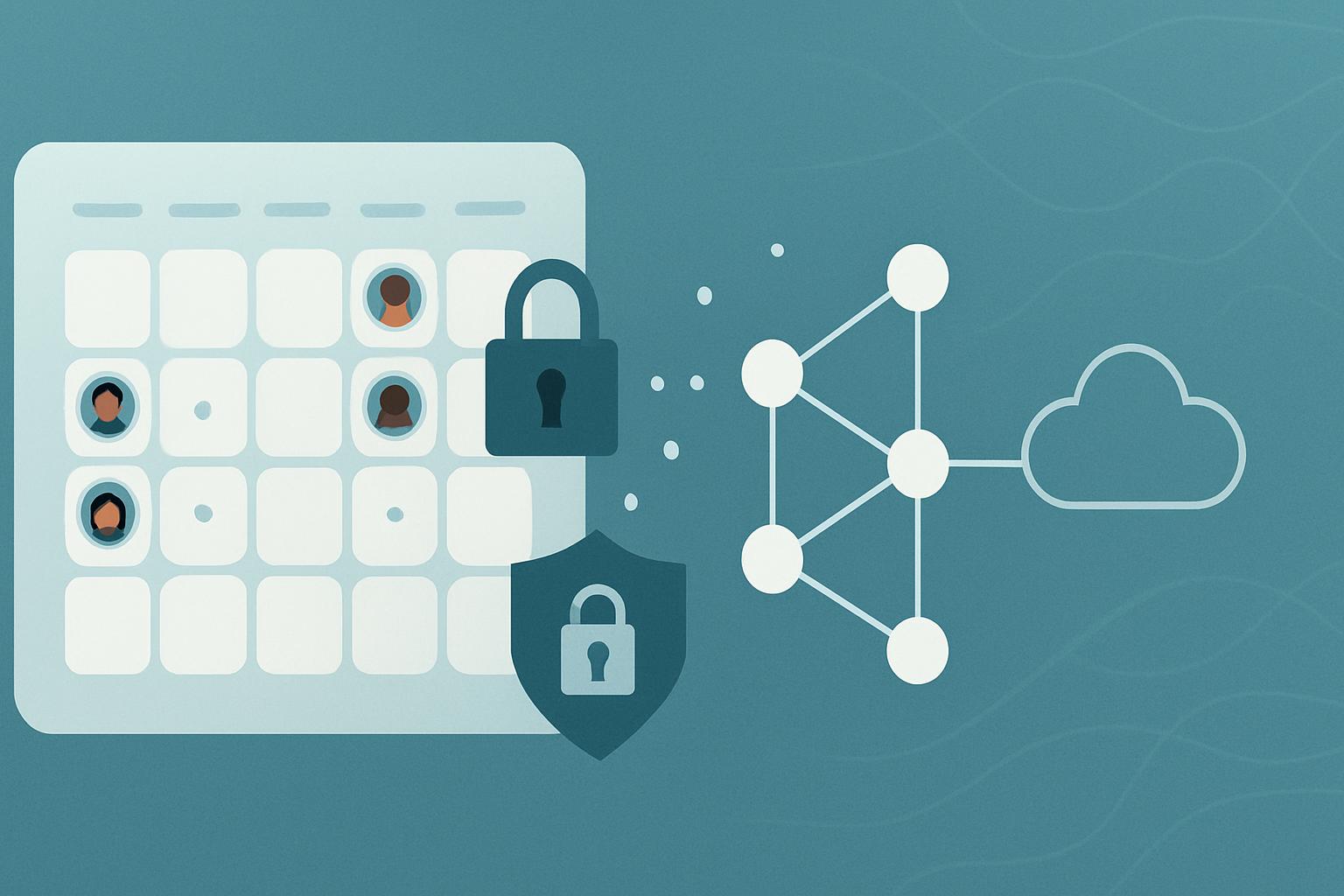
Privacy-preserving calendar data pipelines enable organizations to train scheduling AI models while minimizing leakages of sensitive meeting content and participant identities. Deploying combined techniques—differential privacy, federated learning, secure aggregation, and robust data minimization—reduces disclosure risk by orders of magnitude while retaining useful model performance (typical utility loss: 5–20% depending on technique and dataset size).
Introduction
Organizations building scheduling assistants and meeting analytics tools must balance model utility with strong protection for calendar entries that often contain confidential topics, strategic plans, or private participant data. This article explains practical, enterprise-focused approaches to construct privacy-preserving calendar data pipelines that allow training of scheduling AI without exposing sensitive meetings.
Quick answer: Combine on-device local feature extraction, federated learning or secure aggregation, differential privacy at the training and reporting steps, strict data minimization, and governance controls. These measures, when layered, provide strong protection while allowing effective scheduling models.
Why privacy-preserving calendar data pipelines matter
Which calendar data is sensitive?
Calendar data frequently contains several sensitive elements that increase privacy and business risk:
- Meeting titles and descriptions (strategy, M&A, HR issues)
- Attendee lists and roles (organizational charts, external partners)
- Meeting times and locations (patterns revealing habits or whereabouts)
- Attachments and links (confidential documents)
Business risks of exposure
Exposed calendar data can cause reputational damage, regulatory non-compliance (e.g., GDPR), insider trading concerns, and competitive leaks. For AI teams, using raw calendar content in model training without protections creates a high-risk data pipeline.
Key risk summary: Unprotected model training can leak meeting content or re-identify participants; layered protections reduce re-identification risk and help meet compliance obligations.
Core privacy-preserving techniques
Below are the primary technical approaches used in practice. Teams should combine multiple techniques rather than rely on any one mechanism.
Differential privacy (DP)
DP adds calibrated noise to data, gradients, or aggregated outputs to bound the influence any single record has on the model. For calendar pipelines:
- Use DP during model training (DP-SGD) to protect participant-level records.
- Apply DP to aggregated analytics and reporting to prevent membership inference.
- Select epsilon (privacy budget) aligned with risk and legal requirements; smaller epsilon => stronger privacy but higher utility cost.
DP is mathematically provable and widely adopted for sensitive analytics, but tuning is critical to preserve model quality.
Federated learning (FL)
FL keeps raw calendar entries on user devices or in tenants' environments; only model updates are shared. For enterprise scheduling AI:
- Perform local feature extraction and initial training on-device or in controlled tenant infrastructure.
- Share model gradients or parameters to a central aggregator; never raw calendar text.
- Combine FL with secure aggregation so the server only sees combined updates.
Secure multi-party computation (MPC) and homomorphic encryption (HE)
MPC/HE permit computation on encrypted or secret-shared data. In practice for calendar pipelines:
- Use secure aggregation to compute sum or average gradients without revealing individual contributions.
- HE enables encrypted inference or encrypted aggregation but is computationally heavier—appropriate for high-risk workflows or where cryptographic guarantees are required.
Data minimization, tokenization, and access controls
Privacy-by-design requires reducing what is collected and retained:
- Collect features required for scheduling only (e.g., meeting duration, organizer role, time-of-day) instead of raw text.
- Tokenize or hash identifiers (participants, emails) and map to ephemeral pseudonyms.
- Apply retention limits, strict access controls, and role-based permissions for any raw artifacts kept for debugging.
Designing a privacy-preserving calendar data pipeline (practical steps)
The following numbered steps give a practical roadmap for engineering and product teams building scheduling AI.
Step 1: Inventory and classification
Perform a data inventory and classify calendar fields by sensitivity:
- Map all calendar attributes that feed into model training.
- Label each field: Public, Internal, Confidential, Highly Confidential.
- Set policy on fields disallowed for training (e.g., free-text descriptions with legal/HR tags).
Step 2: Local processing and feature extraction
Shift work to the client or tenant boundary:
- Extract high-level features locally, such as meeting length, recurring flag, time-slot buckets, organizer level.
- Convert sensitive text to structured signals (topic categories) using local classifiers, or avoid using free text entirely.
- Retain only aggregated or hashed identifiers for downstream training.
Step 3: Privacy mechanisms and training workflows
Coordinate training using privacy-first infrastructure:
- Prefer federated or hybrid training so raw records never leave the client.
- Use secure aggregation to combine client updates without exposing contributions.
- Apply DP to model updates and to published metrics.
- Implement anomaly detection to flag abnormal or sensitive updates during training and quarantine them for human review.
Step 4: Evaluation, logging, and monitoring
Monitoring must balance observability with privacy:
- Log training statistics at an aggregated DP-protected level.
- Retain minimal debugging artifacts and ensure log access is audited.
- Continuously evaluate privacy risk using membership inference tests, reconstruction risk checks, and red-team assessments.
Implementation summary: Inventory → local feature extraction → federated or encrypted aggregation → DP-protected training and reporting → continuous monitoring.
Contextual background: key technical concepts
This section provides concise background so business leaders and architects can assess trade-offs between privacy and utility.
Differential privacy: trade-offs and metrics
DP is measured via epsilon (ε) and sometimes delta (δ). Lower ε increases privacy. Typical enterprise deployments choose ε in the single digits for aggregated analytics and may accept slightly higher ε for complex models, always combined with other controls.
Federated learning: orchestration and heterogeneity
FL faces challenges like non-iid client data (calendar patterns vary by role and region), intermittent availability, and system heterogeneity. Robust orchestration is required to ensure representative updates and to avoid bias amplification.
Cryptographic approaches: practicality vs. guarantees
MPC/HE offer strong guarantees but come with computational and engineering overhead. Use them selectively for high-risk pipelines or where legal constraints demand cryptographic protection.
Implementation checklist for business teams
Use this checklist to coordinate privacy, security, and product teams.
- Governance: Establish privacy requirements and acceptable epsilon ranges.
- Data: Complete inventory and sensitivity classification.
- Engineering: Implement local feature extraction and FL or secure aggregation.
- Security: Enforce encryption-in-transit and at-rest, key management, and access controls.
- Legal/Compliance: Map pipeline to regulations (GDPR, CCPA) and update DPA clauses for model training.
- Testing: Run membership inference and reconstruction risk assessments pre-release.
- Monitoring: Setup DP-protected telemetry and auditing for model updates.
Key Takeaways
- Layered protections (local processing, FL, secure aggregation, DP) are essential; no single technique suffices for high-sensitivity calendar data.
- Data minimization and feature engineering reduce exposure and improve privacy-utility trade-offs.
- DP provides mathematical guarantees but requires careful tuning and complementary controls to maintain model utility.
- Cryptography (MPC/HE) is valuable for extreme-risk scenarios but increases complexity and cost.
- Governance, monitoring, and continuous risk assessment are operational requirements—not optional steps.
Frequently Asked Questions
Can we train a useful scheduling model without accessing raw meeting text?
Yes. Many scheduling tasks rely on structured signals—meeting duration, recurrence, time preferences, organizer role, and past acceptance patterns. Local classifiers can convert text to high-level categories while keeping raw text private. Combining those signals with large-scale aggregated patterns yields useful scheduling models.
Does differential privacy prevent all forms of leakage?
No. Differential privacy bounds the influence of individual records but must be combined with measures such as secure aggregation, data minimization, and access controls. Improper parameterization or disallowed data retention can still lead to residual risks.
How does federated learning change deployment complexity?
Federated learning increases orchestration complexity: handling unreliable clients, uneven data distribution, and secure aggregation. It also requires client updates to be authenticated and audited. However, it reduces exposure of raw records and aligns well with enterprise tenant boundaries.
When should we use homomorphic encryption or MPC?
Use cryptographic approaches when the legal or business risk is very high and mathematical confidentiality guarantees are required. For example, cross-organization model training where parties cannot share raw data but need joint models, or when regulators require encrypted computation. Expect higher latency and engineering costs.
What privacy metrics should business stakeholders track?
Track DP parameters (ε, δ) where used, percentage of data processed locally vs. centrally, membership inference risk scores, differential privacy utility loss estimates, and access/audit logs. Map these metrics to business risk tolerances and compliance requirements.
How do we balance model accuracy with privacy constraints?
Run controlled experiments: start with minimal privacy interventions and progressively add protections (e.g., move from local-only features to DP-SGD). Measure utility degradation and use techniques such as feature selection, model architecture tuning, and larger training pools to recover accuracy. Often a modest accuracy trade-off yields substantial privacy gains.
Sources and further reading
- A. McMahan et al., Communications of Federated Learning
- Harvard Privacy Tools: Differential Privacy Overview
- NIST publications on privacy engineering and cryptographic primitives
Adopting privacy-preserving calendar data pipelines is an achievable and necessary step for businesses deploying scheduling AI. By combining technical measures and governance, organizations can train effective models while protecting sensitive meetings and stakeholder trust.
Scheduler
Hand your calendar to an assistant that never drops a thread.
Keep reading

AI Notetakers Are Sitting In on More Meetings Than You Think, Often Without Asking
One in three employed Americans say an AI notetaker has been in their work meetings, and 65% of them say they weren't consistently asked first, according to a July 2026 survey. Here's what that consent gap actually means for teams and legal risk.
![Privacy‑Safe Personal Appointments: Expert Guide [Proven]](https://nuxxt0us9k7umi1n.public.blob.vercel-storage.com/blog-covers/6a4ebc1188d93a9e734f50e2_article-28df6357-c673-43f7-8598-4df42e844f3e.jpeg)
Privacy‑Safe Personal Appointments: Expert Guide [Proven]
Enable Privacy‑Safe Personal Appointments: Let an Assistant Book Health or Family Slots Without Revealing Details —Proven controls. Read expert analysis
Scaling Accurate Speaker Attribution with Hybrid Human + ML
Learn about Speaker Attribution at Scale: Hybrid Human+ML Workflows to Ensure Accurate Transcript Speaker Labels in this comprehensive SEO guide.