Calendar Data Minimalism: Metadata-Only Sharing for Privacy
Calendar Data Minimalism: Share Only the Metadata Assistants Need Without Sacrificing Privacy. Use scoped tokens, consent flows, and local redaction now.
Introduction
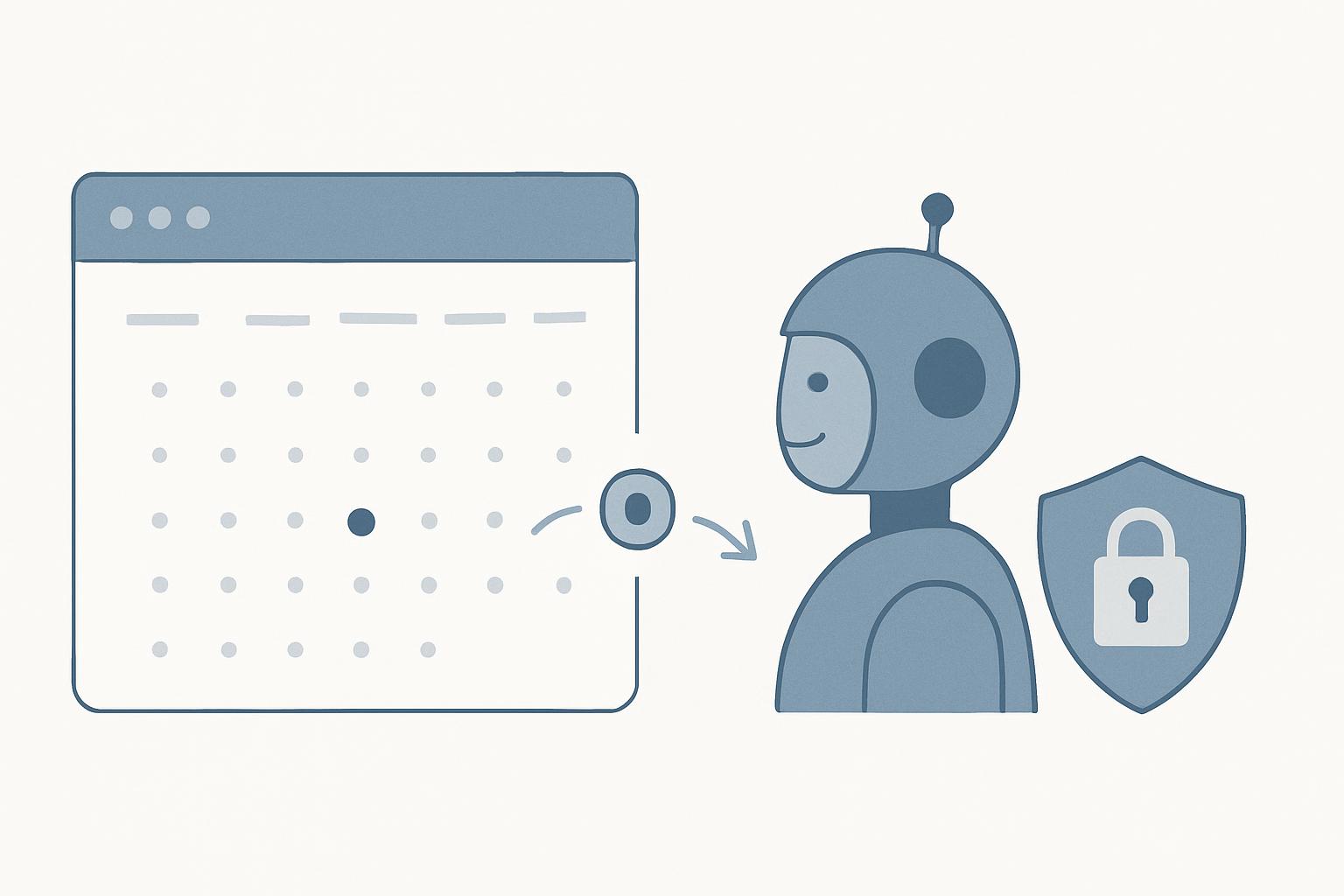
Business professionals increasingly rely on AI assistants to manage calendars, schedule meetings, and coordinate teams. However, full calendar sharing can expose sensitive subjects, attendee lists, and private notes. Calendar Data Minimalism: Share Only the Metadata Assistants Need Without Sacrificing Privacy is an approach that delivers the productivity benefits of automated scheduling while minimizing privacy and compliance risk.
Why metadata-only sharing matters for business professionals
Organizations must balance convenience and confidentiality. Full event details can reveal commercial strategy, personal information, or regulatory exposures. Metadata-only sharing addresses three core needs:
- Preserve productivity: allow assistants to propose times, detect conflicts, and set reminders.
- Reduce risk: prevent leakage of meeting titles, agendas, attendee identities, and notes.
- Support compliance: help meet GDPR, HIPAA, and other data minimization requirements.
Quick answer: What minimal metadata does an assistant typically need?
Contextual background: Metadata vs. content
Understanding the distinction between metadata and content is critical:
- Metadata: Structural attributes about an event — time, duration, timezone, availability flag, and a machine-readable category.
- Content: Human-readable title, agenda, attendee names and emails, location, attachments, and private notes.
Metadata enables scheduling logic without revealing the why, who, or what of a meeting. Many privacy frameworks and standards emphasize data minimization — sharing only what is necessary for the purpose at hand. For scheduling, that purpose is usually time coordination, which metadata can achieve.
What metadata to share: a recommended schema
Below is a practical, minimal schema to support most assistant tasks while minimizing exposure.
- timeWindowStart (ISO 8601 timestamp) — when the meeting can start.
- timeWindowEnd (ISO 8601 timestamp) — latest allowable start or end timestamp.
- durationMinutes — canonical meeting length when fixed.
- availability — enum: busy, free, tentative.
- timezone — IANA timezone identifier.
- meetingCategory — one-word, standardized tag (e.g., "1:1", "review", "standup").
- priority — optional integer or label to prefer scheduling order.
- conflictTolerance — optional tolerance policy for soft conflicts.
Deliberately avoid sharing: attendee emails, event titles, agendas, locations, attachments, and meeting notes unless absolutely required and consented to.
How to implement metadata minimalism in real systems
Implementation spans product UI, API design, access control, and runtime safeguards. Follow this stepwise approach:
- Define minimal scopes: Create OAuth or API scopes such as
calendar.metadata.readseparate fromcalendar.events.read. Scopes should express intent and least privilege. - Consent-first UX: Present concise choices in consent dialogs that list exactly which metadata fields will be shared and for what purpose.
- Server-side redaction: Enforce field-level filtering on the server. Do not rely solely on client controls.
- Short-lived tokens: Issue tokens with short TTLs and bind them to a session and use-case to reduce replay risk.
- Logging and audits: Log access to metadata fields and maintain audit trails for compliance and incident response.
API design patterns
- Offer endpoints like
/v1/calendar/metadatareturning only authorized fields. - Use query params to request only necessary fields (field selection):
?fields=timeWindowStart,durationMinutes. - Return coarse-grained availability where possible (e.g., hourly buckets) to further reduce precision.
Privacy-enhancing technologies (PETs) to combine with minimal metadata
Minimal metadata is stronger when paired with PETs:
- Field-level encryption: encrypt sensitive fields and only decrypt server-side for approved operations.
- Tokenization/pseudonymization: replace direct identifiers with ephemeral tokens.
- Local processing: run sensitive matching on the device and only upload minimal results.
- Differential privacy: add calibrated noise to aggregated analytics when deriving patterns from metadata.
Use cases and mapping to metadata requirements
Map common assistant capabilities to the minimal metadata they need:
- Find available times: needs time windows, duration, timezone, availability.
- Propose meeting slots: same as above; may benefit from priority and meetingCategory.
- Reschedule conflicts: needs conflictTolerance and current availability.
- Time-zone adjustments: needs timezone and timestamps.
Operational practices and governance
Adopt policies and procedures to operationalize metadata minimalism:
- Data classification: Label calendar attributes as sensitive or non-sensitive so engineering teams know what to expose.
- Access reviews: Periodically review which services and assistants have metadata access and why.
- Retention policy: Define TTLs for stored metadata logs and purge them per policy.
- Incident response: Include metadata exposures in IR plans; minimal metadata reduces the blast radius.
Implementation checklist for engineering teams
Follow this ordered checklist to roll out metadata minimalism.
- Audit existing calendar APIs to see what fields are returned.
- Design and deploy narrow scopes (e.g., calendar.metadata.read).
- Update consent and onboarding flows with explicit descriptions.
- Implement server-side field filtering and redaction policies.
- Add short TTL tokens and session binding for assistant access.
- Instrument access logging and regular audits.
- Train product and support teams on what metadata means for users.
Measuring success: KPIs and risk indicators
Track both productivity and privacy outcomes:
- Scheduling success rate (percentage of assistant proposals accepted).
- Time-to-schedule (average time from request to confirmed event).
- Number of sensitive-field access events (should trend down).
- User consent acceptance rates and complaint incidents.
Common pitfalls and how to avoid them
Be aware of mistakes that weaken privacy guarantees:
- Shadow sharing: Avoid secondary channels that leak event titles or attendee data (e.g., email summaries).
- Over-precision: Avoid sharing exact timestamps when coarse-grained windows suffice.
- Insufficient consent language: Use clear, non-technical consent explanations.
Key Takeaways
- Share only the calendar metadata required for the assistant's task: time window, duration, timezone, availability, and optionally a standardized meeting category.
- Use least-privilege API scopes, server-side redaction, short-lived tokens, and consent-first UX to enforce minimalism.
- Combine metadata minimalism with PETs (encryption, tokenization, differential privacy) to further reduce exposure and comply with regulations.
- Measure scheduling effectiveness and privacy KPIs to validate that minimal metadata preserves utility without sacrificing confidentiality.
Frequently Asked Questions
What is calendar metadata minimalism and why should my organization adopt it?
Calendar metadata minimalism is the practice of sharing only structural calendar attributes (times, durations, availability, timezone) with automated assistants, avoiding event content like titles and attendee lists. Organizations should adopt it to reduce data exposure, help meet legal minimization requirements, and lower the risk of leaking sensitive business or personal details while retaining assistant-driven productivity.
Will sharing only metadata reduce the assistant's usefulness?
Not for most scheduling tasks. Assistants can find times, propose slots, and resolve conflicts using metadata. Some advanced features (contextual agenda generation or personalized reminders) require content access; provide those selectively with explicit consent and narrower scopes.
Which technical controls are essential to enforce metadata-only access?
Key controls include: well-defined OAuth/API scopes, server-side field-level redaction, short-lived tokens, session binding, logging and auditing of metadata access, and consent UIs that clearly state what is shared and why.
How does metadata minimalism help with compliance (GDPR, HIPAA)?
These regulations emphasize data minimization and purpose limitation. By defaulting to the smallest data set necessary for scheduling, organizations reduce the volume of personal data processed, making it easier to document lawful bases, manage retention, and respond to data subject requests.
Can assistants use pseudonymous identifiers to coordinate attendees?
Yes. Tokenization or pseudonyms let the assistant refer to participants without exposing real identities. Tokens should be ephemeral and resolvable only by authorized services. This pattern preserves coordination functionality while protecting attendee privacy.
What metrics should teams track after implementing metadata minimalism?
Track scheduling success rate, average time-to-schedule, number of sensitive-field access events, user consent acceptance rates, and privacy incident counts. These KPIs show whether minimal metadata preserves productivity and reduces exposure.
Sources
Relevant standards and guidance include RFC 5545 iCalendar for event models, GDPR data minimization principles, and NIST privacy framework recommendations for data governance. For implementation patterns, see platform docs for OAuth scopes and best practices on field-level encryption.
Sources: RFC 5545 (iCalendar), GDPR guidance, NIST Privacy Framework.
Scheduler
Hand your calendar to an assistant that never drops a thread.
Keep reading

AI Notetakers Are Sitting In on More Meetings Than You Think, Often Without Asking
One in three employed Americans say an AI notetaker has been in their work meetings, and 65% of them say they weren't consistently asked first, according to a July 2026 survey. Here's what that consent gap actually means for teams and legal risk.
![Privacy‑Safe Personal Appointments: Expert Guide [Proven]](https://nuxxt0us9k7umi1n.public.blob.vercel-storage.com/blog-covers/6a4ebc1188d93a9e734f50e2_article-28df6357-c673-43f7-8598-4df42e844f3e.jpeg)
Privacy‑Safe Personal Appointments: Expert Guide [Proven]
Enable Privacy‑Safe Personal Appointments: Let an Assistant Book Health or Family Slots Without Revealing Details —Proven controls. Read expert analysis
Scaling Accurate Speaker Attribution with Hybrid Human + ML
Learn about Speaker Attribution at Scale: Hybrid Human+ML Workflows to Ensure Accurate Transcript Speaker Labels in this comprehensive SEO guide.