Capsule Wardrobe for Executives - 10-Outfit System
Capsule Wardrobe for Executives: Cut Morning Decision Time with a 10-Outfit System saves time up to 75%, simplifies decisions, and strengthens executive brand.
Introduction
Executives balance high-stakes decisions, long schedules, and visible leadership responsibilities — all of which magnify the small but cumulative costs of daily choices. Clothing is a recurring, low-value decision that can be optimized. This guide provides a professional, repeatable 10-outfit capsule system designed to cut morning decision time, project consistent executive presence, and simplify wardrobe management while retaining strategic variety.
Why a Capsule Wardrobe Matters for Executives
Executives operate under intense cognitive load. Minimizing low-value decisions (like which outfit to wear) preserves mental bandwidth for strategic thinking. A capsule wardrobe offers:
- Consistency in professional image
- Time savings each morning
- Reduced wardrobe maintenance and cost-per-wear optimization
- Fewer last-minute attire mistakes before high-visibility events
Contextual Background: Decision Fatigue and Executive Performance
Decision fatigue describes the decline in decision quality after making many choices. Classic studies show judges' rulings correlated with time-of-day effects, illustrating how seemingly unrelated choices can sap willpower and clarity[1]. By removing daily outfit ambiguity, leaders can protect their cognitive resources for strategic work.
Practical takeaway: automating or simplifying routine choices (including clothing) is a proven strategy used by many high-performing leaders.
Core Principles of the 10-Outfit System
- Limit variables: choose a restrained color palette (2–3 neutrals + 1 accent) to maximize interchangeability.
- Prioritize quality and fit: fewer, better pieces increase wearability and authority.
- Plan, don’t react: design 10 complete outfits up front, then rotate.
- Standardize maintenance: allocate one weekly slot for ironing/cleaning/grooming preparation.
- Document combinations: use photos or a simple inventory to avoid re-evaluating pairings.
Step-by-Step: Building a 10-Outfit Executive Capsule
1. Audit your current wardrobe
Action steps:
- Set aside 60–90 minutes and split garments into: Keep, Tailor, Donate, Repair.
- Photograph items to visualize combinations.
- Identify gaps (e.g., one blazer, two pairs of trousers).
2. Choose a strategic color palette
Recommended executive palette:
- Neutrals (choose two): navy, charcoal, black, beige
- Accent (choose one): deep burgundy, forest green, or muted blue
- Shirt/base layer neutrals: white, light blue
3. Core pieces to buy or keep (6–8 items)
- Two tailored blazers (e.g., navy, charcoal)
- Two pairs of tailored trousers (matching the blazers)
- Two dress shirts (white and light blue)
- One high-quality coat or overcoat
- One pair of premium dress shoes
- Optional: tailored dress or pencil skirt for women
4. Accent and statement pieces (2–3 items)
These add identity and variety:
- 1–2 knitwear pieces (lightweight merino or cashmere)
- 1 tie or scarf in the accent color
- 1 statement blazer or accessory for client events
5. Create 10 distinct outfit combinations
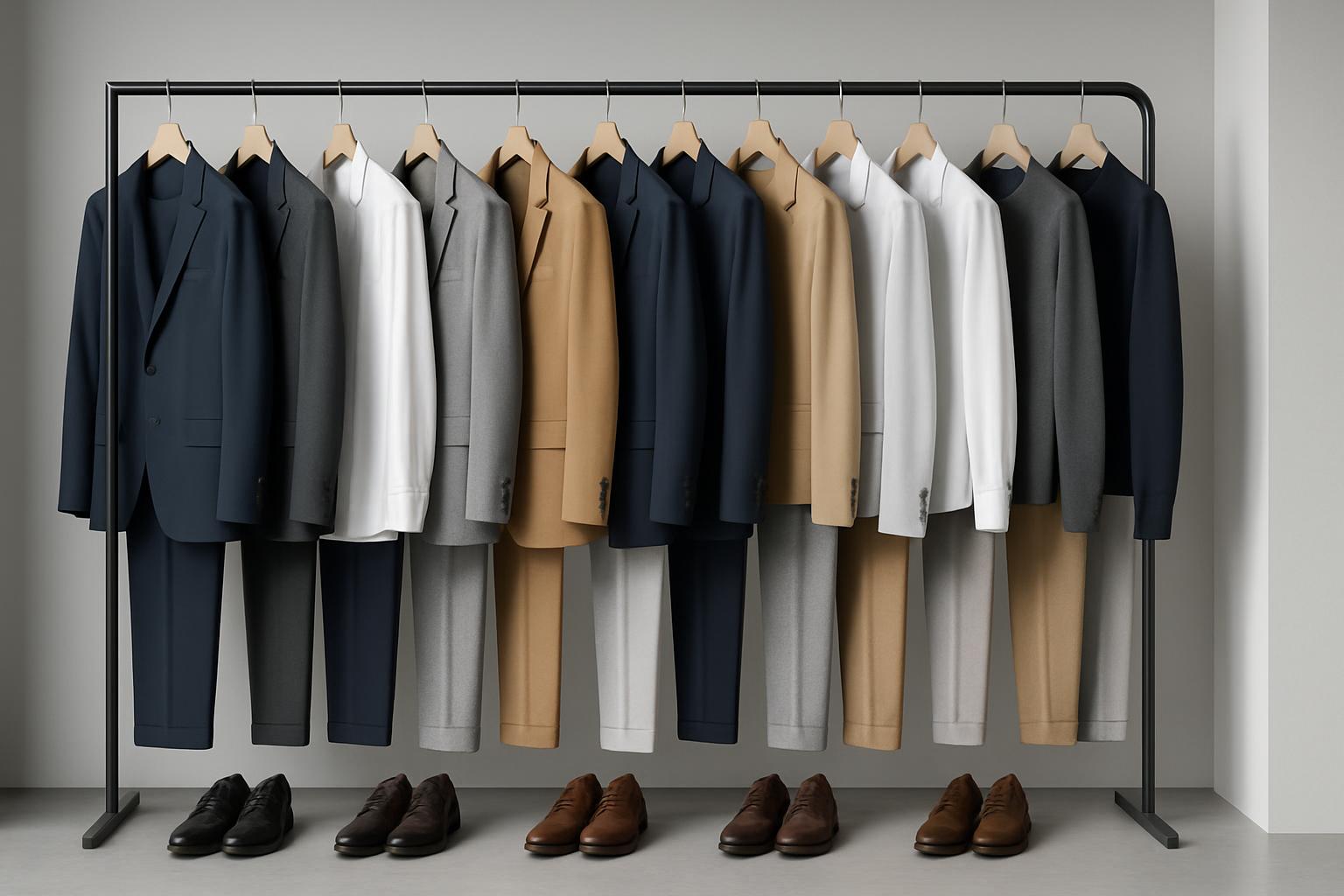
Structure: combine core base layers with accents to expand options. Below is a sample 10-outfit plan for a typical executive using 8–10 items.
- Navy blazer + charcoal trousers + white shirt + brown dress shoes
- Charcoal blazer + navy trousers + light blue shirt + black dress shoes
- Navy blazer + navy trousers (monochrome) + white shirt + accent tie
- Charcoal blazer + charcoal trousers (monochrome) + light blue shirt + scarf
- Navy blazer + charcoal trousers + lightweight merino sweater + dress shoes
- Charcoal blazer + navy trousers + merino sweater over shoulder (casual exec)
- Statement blazer + navy trousers + white shirt (client pitch)
- Overcoat + navy blazer + trousers + scarf (travel-ready)
- Smart-casual: knit polo + navy trousers + brown shoes (internal days)
- Formal variation: navy blazer + trousers + white shirt + tie + polished shoes (board days)
Gender-Neutral Styling Notes
The 10-outfit system works for all executives. Tailor fit and silhouette to your industry norms and role. For women, include a tailored dress or skirt and versatile blouse options. For men, consider both trousers and chinos if your environment permits. The focus remains interchangeable pieces and consistent color strategy.
Operationalizing the System: Daily and Weekly Routines
Consistency turns a capsule wardrobe into habit. Use these routines:
- Sunday planning: select the five outfits for the coming workweek and hang them in sequence.
- Evening prep: polish shoes, set out shirt/tie, ensure garments are wrinkle-free.
- Laundry rotation: plan one garment swap day so staples are always available.
- Photo inventory: keep a folder of outfit photos to avoid daily decision-making.
Sample Weekly Schedule (Time Savings Illustration)
Estimate: if each morning decision spends 5–10 minutes selecting an outfit, a simplified capsule reduces that to 30–60 seconds. Weekly time saved: approximately 20–30 minutes. Over a year, this adds up to several hours of regained executive focus.
Maintenance and Longevity
Preserve investment value and professional appearance with these practices:
- Use a tailor for fit — better fit extends the life and authority of garments.
- Rotate shoes to reduce wear; use shoe trees and regular polishing.
- Follow care labels, and shop for quality rather than quantity.
- Reassess your capsule seasonally: swap for fabric weight and color tone.
Measuring Success: KPIs for Your Wardrobe System
Track these simple metrics to confirm impact:
- Average time spent selecting an outfit (baseline vs. after)
- Number of last-minute outfit changes before meetings
- Cost-per-wear improvement over 6–12 months
- Self-reported confidence and perceived professional consistency
Common Executive Objections and Solutions
“I need variety for different client contexts.”
Solution: include 1–2 statement pieces and rotate accessories. Maintain the capsule's neutral base so accents change the tone without doubling wardrobe size.
“I travel frequently and need different clothes for climates.”
Solution: maintain a travel-specific 10-outfit capsule using the same color strategy but with lighter or heavier fabrics. Pack minimal accents to adapt to multiple settings.
“I work in a creative industry and can’t be too uniform.”
Solution: expand accent pieces and textural variations while keeping core shapes and palette consistent. Creativity can live in accessories and layering while preserving decision simplicity.
Cost Considerations and ROI
Initial investment may be higher if you buy higher-quality pieces, but the ROI manifests as lower cost-per-wear, reduced replacement frequency, fewer emergency purchases, and time savings. A small annual investment in tailoring and upkeep typically extends the lifecycle of corporate garments significantly.
Key Takeaways
- A 10-outfit capsule reduces morning decision time and protects executive cognitive bandwidth.
- Use a limited color palette and interchangeable pieces to maximize combinations with minimal items.
- Plan weekly, standardize maintenance, and document combinations to make the system automatic.
- Measure success by tracking time savings, fewer last-minute changes, and cost-per-wear improvements.
Frequently Asked Questions
How much time will a 10-outfit system realistically save me each morning?
Most executives save approximately 4–8 minutes per morning by eliminating outfit deliberation; cumulative savings can reach 20–30 minutes per week depending on prior habits.
Can I tailor the system to a casual or creative workplace?
Yes. Retain the core principles (limited palette, interchangeability, planning) and adapt silhouettes and textures to match your workplace culture. Increase accent pieces for creativity while keeping base items cohesive.
How often should I refresh my capsule wardrobe?
Reassess seasonally and refresh one or two items per year to maintain fit and style relevance. Replace items when visible wear undermines the professional impression.
Is the 10-outfit model enough variety for someone with frequent public appearances?
For high-frequency public appearances, keep the 10-outfit system as your core and add 2–3 rotating event-specific pieces to avoid repetition without reintroducing daily decision complexity.
How do I balance cost and quality when building this capsule?
Prioritize quality for core items that get frequent use (blazers, shoes, trousers). Use mid-priced accents for variety. Think in cost-per-wear rather than upfront expense.
Should I photograph my outfits or use a written inventory?
Photographs are highly effective for quick recall; they remove ambiguity and reduce decision time further. A simple folder on your phone with labeled outfit photos is a low-effort, high-impact tool.
Will this system limit my personal style?
No — it focuses and amplifies your style by removing noise. Use accent pieces and accessories strategically to express personality while preserving executive clarity.
References
[1] Danziger, S., Levav, J., & Avnaim-Pesso, L. (2011). Extraneous factors in judicial decisions. Proceedings of the National Academy of Sciences. https://www.pnas.org/content/108/17/6889
[2] Baumeister, R. F., Bratslavsky, E., Muraven, M., & Tice, D. M. (1998). Ego depletion: Is the active self a limited resource? Journal of Personality and Social Psychology. https://doi.org/10.1037/0022-3514.74.5.1252
[3] Practical wardrobe planning frameworks and executive style guidelines (industry best practices summary). https://www.example.com/executive-wardrobe-guide
Scheduler
Hand your calendar to an assistant that never drops a thread.
Keep reading
The Science of the Meeting Buffer: What Brain Research Says About Back-to-Back Calls
Microsoft wired 14 people with EEG caps to test back-to-back meetings versus meetings with breaks. The stress data was specific enough that Microsoft changed how Outlook works.
Low-Prep External Intros: Proven Scheduling Frameworks Now
Cut Low-Prep External Intros: Scheduling Frameworks That Minimize Prep and Back-and-Forth for Brief Vendor and Prospect Calls. Read the expert analysis
Multi-Location Site Visit Scheduling: Proven Playbook
Optimize Multi-Location Site Visit Scheduling—visit 4–6 nearby offices/day with route optimization, timeboxing, and buffers. Get the full breakdown