Marketplaces for AI-Managed Office Hours: New Models
Marketplaces for AI-Managed Office Hours: New Business Models Letting Experts Monetize Time with Automated Booking and Fulfillment - Scale bookings & revenue.
Introduction
This article explains how marketplaces for AI-managed office hours create new business models that let professionals monetize expertise through automated booking and fulfillment. It covers platform design, monetization strategies, technology stacks, operational models, and go-to-market tactics targeted to business professionals evaluating or building these marketplaces.
What is an AI-managed office hours marketplace?
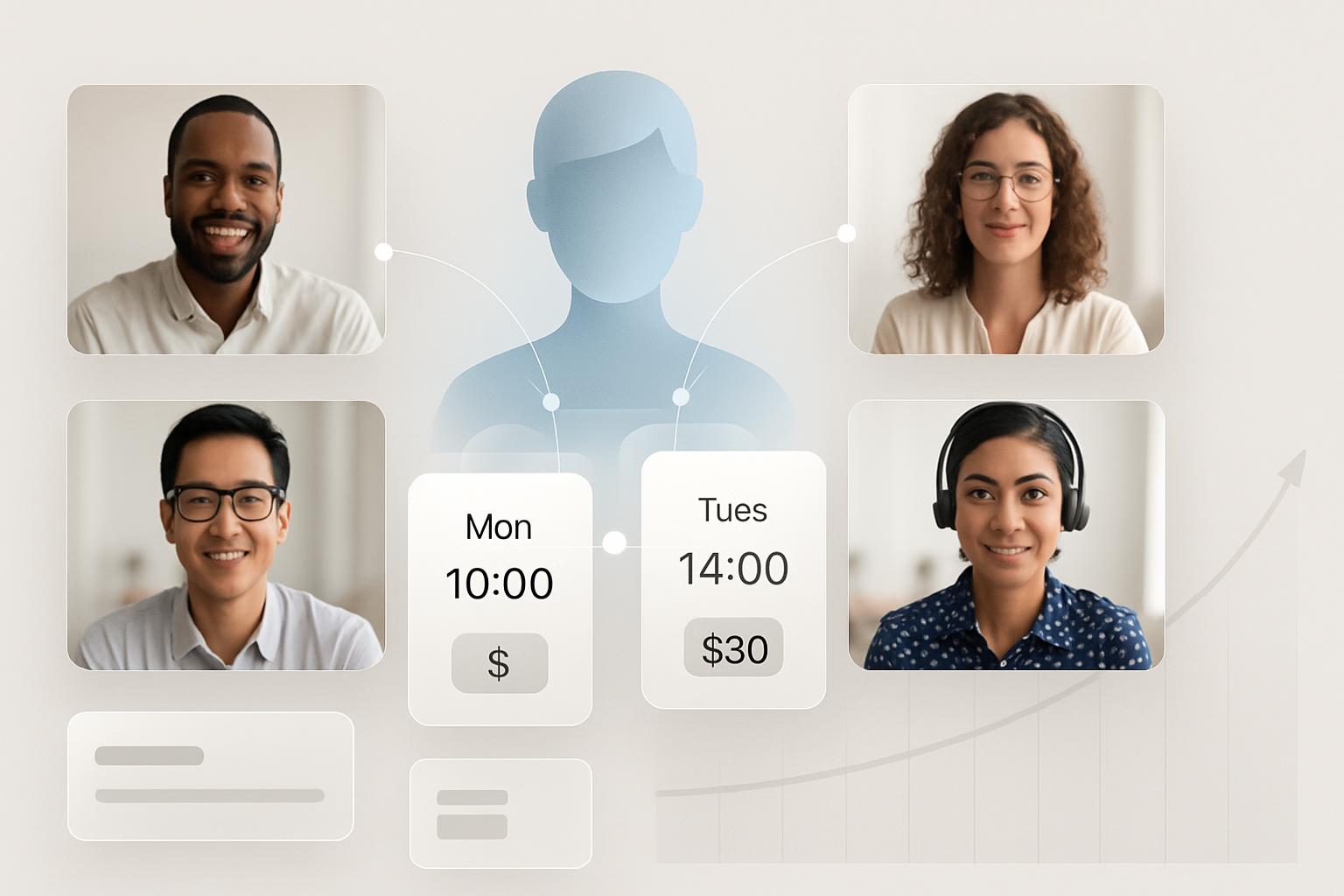
An AI-managed office hours marketplace is a platform that connects experts with buyers for short, scheduled interactions (consultations, coaching, mentoring, troubleshooting). The platform automates the end-to-end workflow using AI: availability management, intelligent matching, pricing optimization, calendar synchronization, reminders, content capture, and fulfillment (transcripts, recordings, follow-ups).
Key components
- Catalog and discovery: searchable expert profiles with microservices for tagging and expertise signals.
- Automated booking: calendar integrations, time-zone handling, and buffer rules.
- AI matching: recommendation engines that match intent, problem type, industry and budget.
- Dynamic pricing: yield management, discounts for packages, surge pricing for demand peaks.
- Fulfillment automation: transcripts, action items, billing, and certificate generation.
- Trust and safety: identity verification, reviews, dispute resolution, compliance checks.
Quick Answer: How do experts monetize time?
Why these marketplaces are a new business model
Traditional consulting and advisory models rely on long engagements and bespoke contracts. AI-managed office hours transform time into a scalable, productized service that is:
- Predictable: fixed lengths and outcomes make billing and expectations clearer.
- Scalable: experts can increase throughput with automation and templates.
- Accessible: buyers gain on-demand access to niche expertise without long procurement cycles.
- Data-driven: platforms leverage usage and outcome data to improve matching and pricing.
Business model variants
- Pay-per-session: single bookings with platform fees or revenue share.
- Subscription access: monthly or annual access to recurring office hours or credits.
- Bulk packages: discounted bundles of sessions for teams or cohorts.
- White-labeled enterprise deployments: license the marketplace software to large firms for internal expert networks.
- Marketplace plus managed services: platform handles matching while offering human-assisted onboarding and quality assurance as add-ons.
Quick Answer: Revenue and pricing mechanics
Product and operational design
Designing a marketplace that efficiently monetizes expert time involves product decisions and operational policies:
Scheduling and availability
- Sync with multiple calendars (Google, Microsoft) and support buffer times and blackout windows.
- Allow recurring office hour slots plus ad-hoc on-demand slots for flexibility.
Booking flow and cancellations
- Collect intent and expected outcome during booking to improve matching quality.
- Implement clear cancellation and rescheduling policies supported by prorated refunds or credits.
- Use automated reminders and AI-based no-show risk scoring to reduce attrition.
Fulfillment and scaling
- Automate session recording, transcription, and summary generation to increase perceived value.
- Offer templated agendas and follow-up tasks to standardize outcomes and shorten delivery time.
- Enable group sessions or office-hour cohorts for higher leverage of expert time.
Technology stack and AI capabilities
Key technical capabilities that differentiate marketplaces:
- Matching algorithms that combine profile signals, past outcomes, buyer intent, and availability.
- Natural language processing (NLP) to extract session outcomes, tag content, and improve searchability.
- Pricing engines using demand forecasting and price elasticity models.
- Workflow automation for billing, reminders, and follow-up deliverables.
- Secure recording and data storage with access controls and retention policies.
Quick Answer: Trust, compliance and payments
Go-to-market and demand generation
Successful marketplaces prioritize two-sided network growth:
- Seed the platform with high-quality experts using targeted outreach and incentives (reduced fees, promotional credits).
- Acquire buyers through content marketing, partnerships, and account-based selling for enterprise plans.
- Design viral loops: shared session notes, referral credits, or co-branded events to drive network effects.
Pricing experiments and monetization tests
- Start with flat transaction fees, then test dynamic pricing models and subscription bundles based on retention metrics.
- Measure conversion from discovery to booking, average session value, and lifetime value by cohort.
Key metrics to track
- Utilization rate: percentage of an expert’s available slots that are booked.
- Take rate: marketplace percentage of revenue retained.
- ARPU: average revenue per user or expert.
- Repeat purchase rate and retention: indicator of ongoing demand for an expert’s office hours.
- Net promoter score (NPS) and session satisfaction scores.
Quick Answer: Typical results and ROI
Operational challenges and risk management
Key challenges and mitigation strategies include:
- No-shows and cancellations: enforce modest fees, use AI reminders, and implement credit-based refunds.
- Quality control: require onboarding, collect structured feedback, and apply performance gating.
- Legal exposure: use standard contracts, scope-of-work documents, and insurance requirements for high-risk categories.
- Data privacy: implement RBAC, encryption at rest and in transit, and data retention policies aligned with local law.
Contextual background: Why automation matters
Scheduling friction, manual invoicing and variable session quality historically constrained small-scale expert engagements. Automation removes administrative overhead and allows suppliers to focus on delivering value. As asynchronous collaboration tools and AI summarization mature, the friction cost of short, high-value interactions drops measurably, creating a larger addressable market for micro-consulting services.
Case examples and use cases
- Startup mentoring: accelerators offer scheduled office hours with vetted advisors, bundled into a cohort subscription.
- Specialized legal clinics: limited-scope, paid consultations for entrepreneurs, with automated document templates as follow-up.
- Enterprise subject-matter experts (SMEs): internal marketplaces let employees book time with product or security experts, improving speed of resolution.
- Professional development: coaches sell hour-long review sessions plus AI-generated action plans and progress tracking.
Quick Answer: Enterprise vs. public marketplaces
Implementation roadmap for builders
- Define the minimum viable marketplace: core booking, payments, expert onboarding, and calendar sync.
- Launch a controlled pilot with a small set of experts and buyers to validate product-market fit.
- Iterate on pricing and fulfillment automation based on pilot metrics (utilization, conversion, satisfaction).
- Invest in AI capabilities for matching and post-session summarization once volume justifies models.
- Scale by adding packages, enterprise features, and integrations with CRM or LMS systems.
Key Takeaways
- AI-managed office hours marketplaces productize expert time, enabling scalable monetization through automation.
- Successful platforms combine scheduling, matching, dynamic pricing and fulfillment to increase utilization and revenue for experts.
- Business models include pay-per-session, subscriptions, packages, and white-label enterprise deployments.
- Critical metrics are utilization rate, take rate, ARPU, and retention—optimize these through pricing and operational automation.
- Risk management requires controls for no-shows, quality assurance, legal scope, and data privacy.
Frequently Asked Questions
How do marketplaces prevent no-shows and late cancellations?
Platforms combine cancellation policies, nominal prepayment, automated reminders, and AI-driven risk scoring to reduce no-shows. Many marketplaces offer credits for rescheduling and small penalties for last-minute cancellations to protect expert time.
What pricing model maximizes expert revenue?
There is no one-size-fits-all. Common approaches are per-session pricing for flexibility, subscriptions for predictable recurring revenue, and packages for volume buyers. Pricing experiments and elasticity testing are essential; dynamic pricing tied to demand can increase short-term revenue while subscriptions increase long-term value.
How does AI improve matching quality?
AI leverages past session outcomes, profile signals, buyer intent keywords, and availability to recommend experts likely to deliver a good outcome. NLP extracts intent from bookings and post-session summaries to refine future matches and optimize discoverability.
Are these marketplaces secure enough for sensitive consultations?
Yes, if configured with enterprise-grade controls: encrypted communications, strict access control, signed confidentiality agreements, and audit logs. Specific regulatory requirements (sector-dependent) must be addressed through contractual and technical measures.
How much does it cost to build a marketplace like this?
Costs vary widely by scope. A minimal viable product with booking, payments, and profiles can be built for a modest budget using SaaS components, while production-grade platforms with native AI, enterprise integrations and compliance tooling will require higher investment and dedicated engineering and legal resources.
Can experts use multiple marketplaces simultaneously?
Yes. Experts often list availability across platforms; calendar syncing and buffer rules help prevent double-booking. Some marketplaces offer exclusivity agreements for top-tier programs in exchange for reduced fees or promotional support.
What business types benefit most from these marketplaces?
Startups, professional services, training providers, legal and financial consultants, and enterprise HR or product organizations benefit most. Any domain where short, high-value interactions deliver outsized impact is a strong fit.
Sources
Industry reports and market observations on gig and expert marketplaces, AI scheduling trends, and platform economics informed this article. For regulatory specifics consult legal counsel and applicable jurisdictional guidance.
Scheduler
Hand your calendar to an assistant that never drops a thread.
Keep reading

What the Data Says About Why Your Work Calendar Feels Broken
The average knowledge worker loses 103 hours a year to unnecessary meetings, and half of all meetings land right in the middle of peak focus hours, per Asana and Microsoft's own research. Here's what the data says is actually breaking calendars, and where AI agents can help.
![Personal CRM for Busy Professionals — Proven [Expert Guide]](https://nuxxt0us9k7umi1n.public.blob.vercel-storage.com/blog-covers/6a4ebc1bc9f0db5df88f43d4_article-4c713aac-f045-433e-a0f9-fa40d8d41b92.jpeg)
Personal CRM for Busy Professionals — Proven [Expert Guide]
Discover Personal CRM for Busy Professionals: Use Basic AI to Remember Names, Promises, and Follow‑Ups Without Extra Effort — Get the full breakdown

Paper-to-Calendar Made Easy: How to Capture Notes, Sticky Ca
Learn about Paper‑to‑Calendar Made Easy: Capture Notes, Sticky Cards and Voice Memos and Turn Them into Calendar Actions Using Basic AI Tools in this comprehensive SEO guide.