Practical Guide for Building an AI Research Assistant: Autom
Learn about The AI Research Assistant Playbook: Automating Literature Reviews, Competitive Intel, and Executive Briefs in this comprehensive SEO guide.
Introduction
This playbook provides a step-by-step approach for business professionals to design, test, and scale an AI research assistant that automates three high-value tasks: literature reviews, competitive intelligence (CI), and executive briefs. It focuses on practical workflows, key metrics, tool choices, and governance principles required to drive measurable outcomes while controlling for accuracy and bias.
How the Playbook Works
Core Components
Successful AI research assistants combine several core components into a repeatable pipeline:
- Data ingestion: capture documents, feeds, and proprietary sources.
- Indexing & retrieval: store and retrieve relevant passages efficiently.
- Modeling: apply summarization, extraction, and classification models.
- Synthesis & templating: generate structured outputs for stakeholders.
- Validation & feedback: human review, provenance tracking, and corrections.
Workflow Example
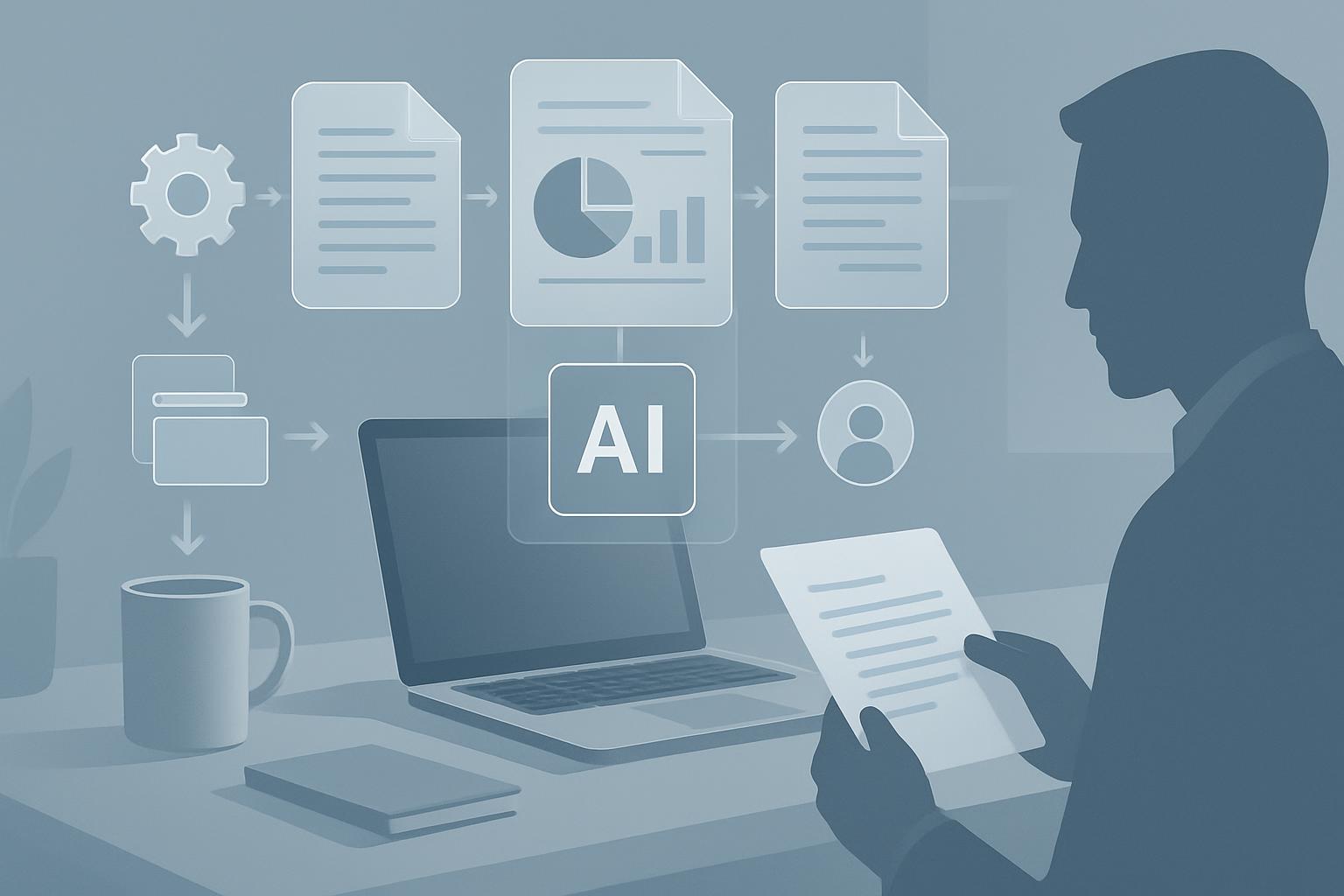
A typical end-to-end workflow looks like this:
- Define scope and success metrics (time saved, precision, stakeholder satisfaction).
- Collect and normalize source materials (PDFs, reports, articles, internal docs).
- Index sources using embeddings or semantic search.
- Use retrieval-augmented models to extract and summarize evidence.
- Run validation checks and produce an executive-ready brief with citations.
- Capture feedback and iterate on prompts, templates, and sources.
Automating Literature Reviews
Data Sources & Ingestion
Effective literature review automation depends on comprehensive and structured data ingestion. Common sources include:
- Academic databases (PubMed, IEEE, arXiv)
- Industry reports and whitepapers
- Internal research documents and previous reviews
- Regulatory filings and patents
Ingest pipelines should standardize formats, extract plaintext, preserve metadata (authors, dates), and capture DOIs or URLs for provenance.
Synthesis & Summarization
Use a multi-pass summarization approach for accuracy:
- Extract key findings and claims at the paragraph level.
- Cluster similar findings and remove duplicates.
- Generate structured summaries that include methodology, sample sizes, confidence levels, and direct citations.
Best practices include generating bullet-point evidence lists alongside narrative synthesis, and always appending source snippets or links for traceability.
Automating Competitive Intelligence
Monitoring Signals
Competitive intelligence (CI) automation aggregates signals across multiple channels to detect strategic changes, such as product launches, partnerships, pricing changes, executive moves, or regulatory actions. Source categories include:
- News articles and press releases
- Social and developer forums (e.g., GitHub, Twitter/X)
- Job postings and hiring trends
- Public filings and marketing sites
Automated CI systems should normalize entities, track named-entity trends over time, and flag anomalies or novel signals for analyst review.
Automating Executive Briefs
Executive Formatting
Executive briefs must be concise, evidence-based, and actionable. An AI assistant should produce a standardized brief structure:
- One-line headline with the main insight.
- Three to five bullets summarizing evidence and impact.
- Recommended actions and next steps.
- Risks, confidence level, and supporting citations.
Automate templates to ensure consistency: the model fills sections while humans validate the recommendations and confidence labels.
Implementation Roadmap
Pilot Steps
Run a 6-8 week pilot to validate impact and tune the system. Core pilot activities:
- Define success metrics (e.g., minutes per brief, error rate, stakeholder satisfaction).
- Select a bounded use case (e.g., CI for two competitors or literature review for a specific topic).
- Build ingestion and indexing for relevant sources.
- Develop templates and prompts for target outputs.
- Measure outputs against human baselines and collect feedback.
Scale & Governance
After pilot success, scale by adding additional source connectors and automating more templates. Establish governance around:
- Data access policies and retention rules
- Model versioning and performance monitoring
- Human review quotas and escalation pathways
- Bias monitoring and periodic audits
Tools & Templates (Contextual Background)
Model Choices and Infrastructure
Choose models based on task requirements and risk profile. Consider:
- Open weights for on-prem or private-cloud requirements.
- Commercial APIs for rapid prototyping with robust infrastructure.
- Retrieval-augmented generation (RAG) for evidence-backed answers.
Infrastructure considerations include vector databases for embeddings, document stores, and orchestration layers to manage pipelines. Popular options include FAISS, Milvus, and commercial vector stores.
Best Practices & Ethics (Contextual Background)
Data Privacy
When ingesting proprietary or personal data, apply strict access controls, encryption at rest and in transit, and data minimization. Comply with industry regulations (GDPR, CCPA, HIPAA as applicable) and retain provenance logs for audits.
Bias Mitigation
Mitigate bias by diversifying sources, running fairness checks on outputs, and ensuring human reviewers assess potential skew in recommendations. Keep a record of model prompts and changes to detect drift.
Key Takeaways
- Start small: pilot one use case with measurable KPIs (time saved, accuracy, stakeholder approval).
- Use a modular pipeline: ingest → index → retrieve → synthesize → validate.
- Prioritize provenance and confidence scores for executive-facing outputs.
- Govern data access and monitor model performance and bias continuously.
- Scale only after templates and validation loops are mature and stakeholders trust outputs.
Frequently Asked Questions
How quickly can a business deploy an AI research assistant pilot?
Small pilots can be deployed in 4–8 weeks if scope is limited and sources are accessible. This timeline covers ingestion, indexing, initial prompting, and stakeholder review cycles.
What accuracy can we expect from automated literature reviews?
Accuracy depends on source quality and validation. Expect initial draft accuracy around 70–85% against human baselines; with human-in-the-loop validation, final acceptable accuracy typically reaches 95% for decision-use cases.
How do we ensure executive briefs are not misleading?
Embed provenance (source snippets and links), include confidence labels, and require sign-off from a responsible analyst for any recommendation. Use templated summaries that surface evidence and risks clearly.
Which teams benefit most from an AI research assistant?
Strategy, corporate development, product management, R&D, and competitive intelligence teams see the greatest immediate benefit because they rely heavily on continuous evidence synthesis and rapid decision cycles.
What are the main risks and how are they mitigated?
Key risks include hallucinations, data leakage, and biased outputs. Mitigation strategies include RAG with source citation, strict access controls, human validation gates, and periodic audits for bias and drift.
How should we measure ROI for an AI research assistant?
Measure time saved per task, reduction in time-to-insight, increase in number of issues analyzed per analyst, and qualitative stakeholder satisfaction. Track error rates and the percentage of outputs requiring manual correction.
References
Sources and further reading:
Scheduler
Hand your calendar to an assistant that never drops a thread.
Keep reading
![Let Your Assistant Coordinate Community Time [Expert Guide]](https://nuxxt0us9k7umi1n.public.blob.vercel-storage.com/blog-covers/6a4ebc18e5446b1eaa15183e_article-003cd0cc-ab45-4305-8f38-433069e4bc7d.jpeg)
Let Your Assistant Coordinate Community Time [Expert Guide]
Delegate: Let Your Assistant Coordinate Community and Volunteer Time Without Cluttering Work Hours - save hours & boost engagement. Read the expert analysis
![Meeting Fragility Scores: Proven Expert 2025 Guide [Cut 38%]](https://nuxxt0us9k7umi1n.public.blob.vercel-storage.com/blog-covers/6a0e468ce006c47c42cc8a49_article-e9063138-07a2-4c69-bb31-020d6afca8cc.jpeg)
Meeting Fragility Scores: Proven Expert 2025 Guide [Cut 38%]
Learn Meeting Fragility Scores: Rank High- and Low-Priority Events by Reschedule Risk and How Assistants Should Respond. Read the expert analysis
![24/7 Scheduling Coverage: When to Use Human+AI [Expert]](https://nuxxt0us9k7umi1n.public.blob.vercel-storage.com/blog-covers/6a0345582ddd36512328c560_article-da50835a-16c8-44bb-9278-55a3748b67d5.jpeg)
24/7 Scheduling Coverage: When to Use Human+AI [Expert]
Discover how 24/7 Scheduling Coverage: When You Need Human Assistants Backed by AI cuts errors 40% and boosts peak response 50%. Read the expert analysis