Practical State-by-State Guidance on Recording Business Call
Learn about State-by-State Recording Laws for Business Calls: Practical Guidance for US-Based Assistants and Teams in this comprehensive SEO guide.
Introduction
This article provides practical, state-aware guidance for US‑based business assistants and teams who handle recorded calls. It explains federal and state rules, identifies where all‑party consent is required, offers step‑by‑step compliance checklists, and describes technology and training controls to reduce legal risk. Use the quick answers and checklist as actionable items for call centers, virtual assistants, sales teams, and administrative staff.
How federal and state laws interact
Understanding recording legality begins with federal law, then overlays state statutes. Both layers are relevant: federal law creates a baseline and state law can be stricter. Businesses must comply with both.
What federal law requires
Federal law (18 U.S.C. § 2511) generally permits recording if at least one party to the conversation consents. This is often called "one‑party consent." It governs federal prosecutions and often informs inter‑state disputes, but it does not preempt state laws that provide greater privacy protections. See the statute for details: 18 U.S.C. § 2511.
What state law requires
States interpret and supplement federal standards. A majority of states follow one‑party consent, but several require all parties to consent before recording private communications. State statutes can attach civil and criminal penalties and permit private lawsuits for violations.
Which states require all‑party consent?
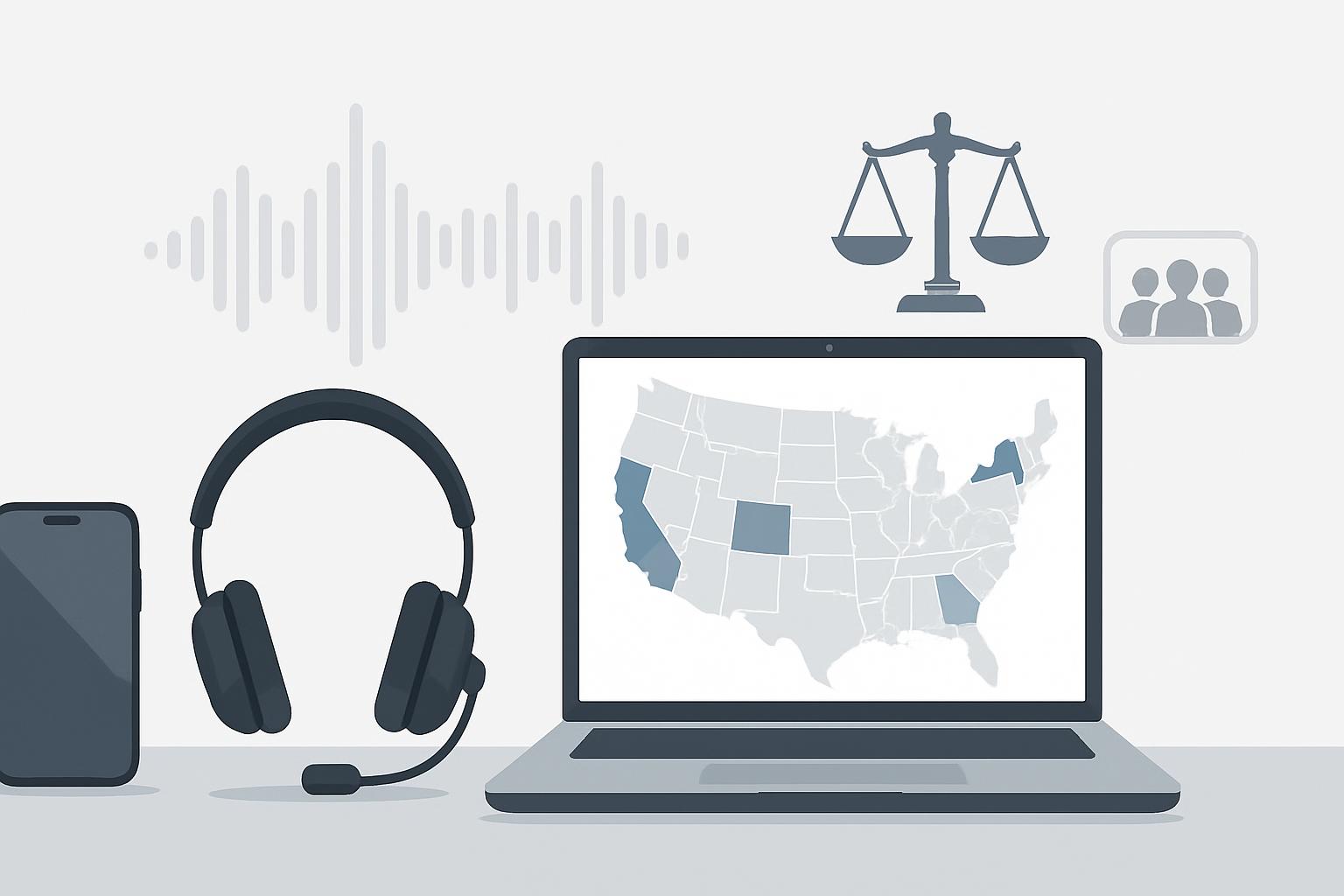
States that require all‑party (often called "two‑party" or "all‑consent") recording vary over time as statutes and case law evolve. Commonly cited all‑party states include California, Florida, Illinois, Maryland, Massachusetts, and some others. The legal landscape changes, so verify current statutes before assuming permissibility. Good aggregate references include state statute compilations and legal resources: see a state-by-state listing at Reporters Committee and practical summaries such as the FindLaw overview: FindLaw: recording phone calls.
Practical list and caveats
- Do not rely on memory or dated lists: statutes and interpretations change — verify current law for each state involved.
- Where a call crosses state lines, look to both participants' locations and applicable state case law.
- If any jurisdiction involved requires all‑party consent, obtain consent from all participants to be safe.
How to handle interstate and multi‑jurisdictional calls
Interstate calls raise the most risk. If a caller is in a one‑party state and the recipient is in an all‑party state, courts may apply the more restrictive law. Businesses should adopt conservative procedures to avoid exposure to criminal liability or civil suits in more protective jurisdictions.
Practical compliance checklist for assistants and teams
Below is a step‑by‑step operational checklist that teams can use to implement compliant recording practices.
Before the call
- Identify participant jurisdictions: ask and record the state/country location of each party when scheduling or at call start.
- Adopt a written recording policy: define when recordings are allowed, retention periods, access controls, and escalation steps for suspected violations.
- Provide training: equip assistants with scripts and decisive escalation paths if a party refuses consent.
- Implement technical controls: configure IVR prompts and automatic recording flags tied to participant location.
During the call
- Open with a consent script: either an automated notice or a staff script that asks for affirmative consent (verbal or electronic).
- Capture consent on the recording: if verbal consent is given, record the time‑stamped statement; if written, store the signed consent with call metadata.
- If consent is withheld, do not record. Offer alternatives (note‑taking, live summaries) and log the refusal.
- Document any jurisdictional uncertainty and contemporaneous steps taken to obtain consent.
After the call
- Store consent records with the call file (audio snippet, timestamp, or written consent reference).
- Apply retention schedules consistent with privacy and industry regulations; purge recordings when they are no longer needed.
- Review flagged or disputed calls promptly and follow your incident response process.
Technology and tools to support compliance
Modern telephony platforms and contact center software can automate many compliance tasks. Recommended technology controls:
- Automated IVR consent prompts that play before recording begins and require a keypress or spoken consent.
- Geo‑location detection tied to phone numbers and IP addresses to infer participant jurisdiction. Note that geo lookups are imperfect; follow up with explicit confirmation when uncertainty exists.
- Call tagging and metadata capture (consent status, consent timestamp, consent method).
- Retention policies and role‑based access controls to limit who can retrieve recordings.
Training, policy, and documentation
Legal compliance depends as much on people and processes as on technology. A strong program includes:
- Clear written policies referenced in employee onboarding and periodic refresher training.
- Sample scripts and objection handling language for assistants (see sample script section below).
- Incident logging and quick escalation to legal or compliance teams for ambiguous scenarios.
- Periodic audits of call recordings and consent records to ensure adherence and to identify process gaps.
Record retention, privacy, and security considerations
Beyond legality of recording, businesses must protect recordings as sensitive data. Consider these controls:
- Encrypt recordings in transit and at rest.
- Limit retention to the minimum business need; document retention schedules.
- Apply access logs and multi‑factor authentication for retrieval.
- Be mindful of overlapping privacy laws (state privacy statutes, sectoral rules such as HIPAA for health information) that may impose additional constraints.
Sign up for our newsletter
Get the latest updates, product launches, and helpful tips delivered straight to your inbox.
Sample consent scripts and templates
Use concise, plain‑language scripts. Below are sample notices you can adapt. Always record affirmative consent where possible.
IVR/automated prompt (short)
"This call may be recorded for quality and training purposes. By continuing, you consent to the recording."
Agent script (verbal, required when state law demands explicit consent)
"Hello — before we begin, please note that this call will be recorded for [quality/training/legal]. Do you consent to this recording?" If the participant says "yes," the agent should state: "Thank you — I have recorded your consent."
Written consent template (for scheduled calls)
Include a checkbox and wording: "I consent to the recording of this call for [purposes]. I understand how the recording will be used and retained." Store electronically with the calendar invite.
Key Takeaways
- Federal law permits one‑party recording, but several states require all‑party consent — always verify state statutes before recording.
- When calls cross state lines, adopt the most protective rule: obtain all‑party consent when any jurisdiction involved requires it.
- Implement standardized consent scripts, IVR prompts, and technology to capture consent and metadata on every recorded call.
- Train staff, document refusals, and maintain encrypted storage with defined retention and access controls.
- When unsure, obtain explicit written or verbal consent from all participants and retain proof.
Frequently Asked Questions
1. Do federal and state laws ever conflict, and which one controls?
Federal law provides a baseline (one‑party consent under 18 U.S.C. § 2511). States can impose more protective requirements; where state law is stricter, businesses must comply with the state rule. Courts often consider both; therefore, comply with the stricter rule when applicable. (See 18 U.S.C. § 2511.)
2. Which specific states require all‑party consent?
Several states have all‑party consent statutes or case law that courts have interpreted as requiring all-party consent for certain private communications. Examples commonly cited include California, Florida, Illinois, Maryland, and Massachusetts, but lists can change. Consult a current state statute compilation such as the Reporters Committee resource: state wiretap statutes.
3. If a caller is in an all‑party state and the agent is in a one‑party state, whose law applies?
Jurisdictional questions are fact‑specific. To reduce exposure, apply the more protective rule and obtain all‑party consent. Many businesses adopt a conservative policy of all‑party consent for interstate calls to avoid conflicting interpretations.
4. Is verbal consent sufficient, or do I need written consent?
Verbal consent is commonly sufficient if it is clearly captured on the recording and includes an affirmative statement. Written consent provides stronger documentary proof, so use written consent for high‑risk calls (legal, financial, healthcare) or when state law suggests it.
5. What if a participant refuses to be recorded?
If consent is refused, do not record the call. Offer alternatives such as manual note‑taking, rescheduling with written consent, or conducting the discussion over secure text or email if appropriate. Log the refusal and escalate if the recording is required by business policy or regulation.
6. How long should I keep recorded calls?
Retention depends on business needs and legal obligations. Define retention periods by call type (e.g., sales calls 1 year, legal calls 7 years) and comply with industry regulations. Always balance retention against privacy laws and minimize keeping recordings longer than necessary.
7. Where can I find an up‑to‑date state list of recording laws?
Reliable sources include the Reporters Committee state wiretap statutes resource and legal research sites. For practical summaries and attorney guidance, see: Reporters Committee and FindLaw. Consult in‑house or outside counsel for binding interpretations.
Sources: 18 U.S.C. § 2511 (Cornell LII); state wiretap statutes (Reporters Committee: rcfp.org); practical state summaries (FindLaw).
Sign up for our newsletter
Get the latest updates, product launches, and helpful tips delivered straight to your inbox.
Scheduler
Hand your calendar to an assistant that never drops a thread.
Keep reading

AI Notetakers Are Sitting In on More Meetings Than You Think, Often Without Asking
One in three employed Americans say an AI notetaker has been in their work meetings, and 65% of them say they weren't consistently asked first, according to a July 2026 survey. Here's what that consent gap actually means for teams and legal risk.
![Privacy‑Safe Personal Appointments: Expert Guide [Proven]](https://nuxxt0us9k7umi1n.public.blob.vercel-storage.com/blog-covers/6a4ebc1188d93a9e734f50e2_article-28df6357-c673-43f7-8598-4df42e844f3e.jpeg)
Privacy‑Safe Personal Appointments: Expert Guide [Proven]
Enable Privacy‑Safe Personal Appointments: Let an Assistant Book Health or Family Slots Without Revealing Details —Proven controls. Read expert analysis

Scaling Accurate Speaker Attribution with Hybrid Human + ML
Learn about Speaker Attribution at Scale: Hybrid Human+ML Workflows to Ensure Accurate Transcript Speaker Labels in this comprehensive SEO guide.