Real-Time Agenda Rewriter: Agile Meeting Decisions Now
Real-Time Agenda Rewriter adapts meeting flow with generative AI—speeding decisions, boosting alignment, reducing wasted meeting time, with better follow-up.
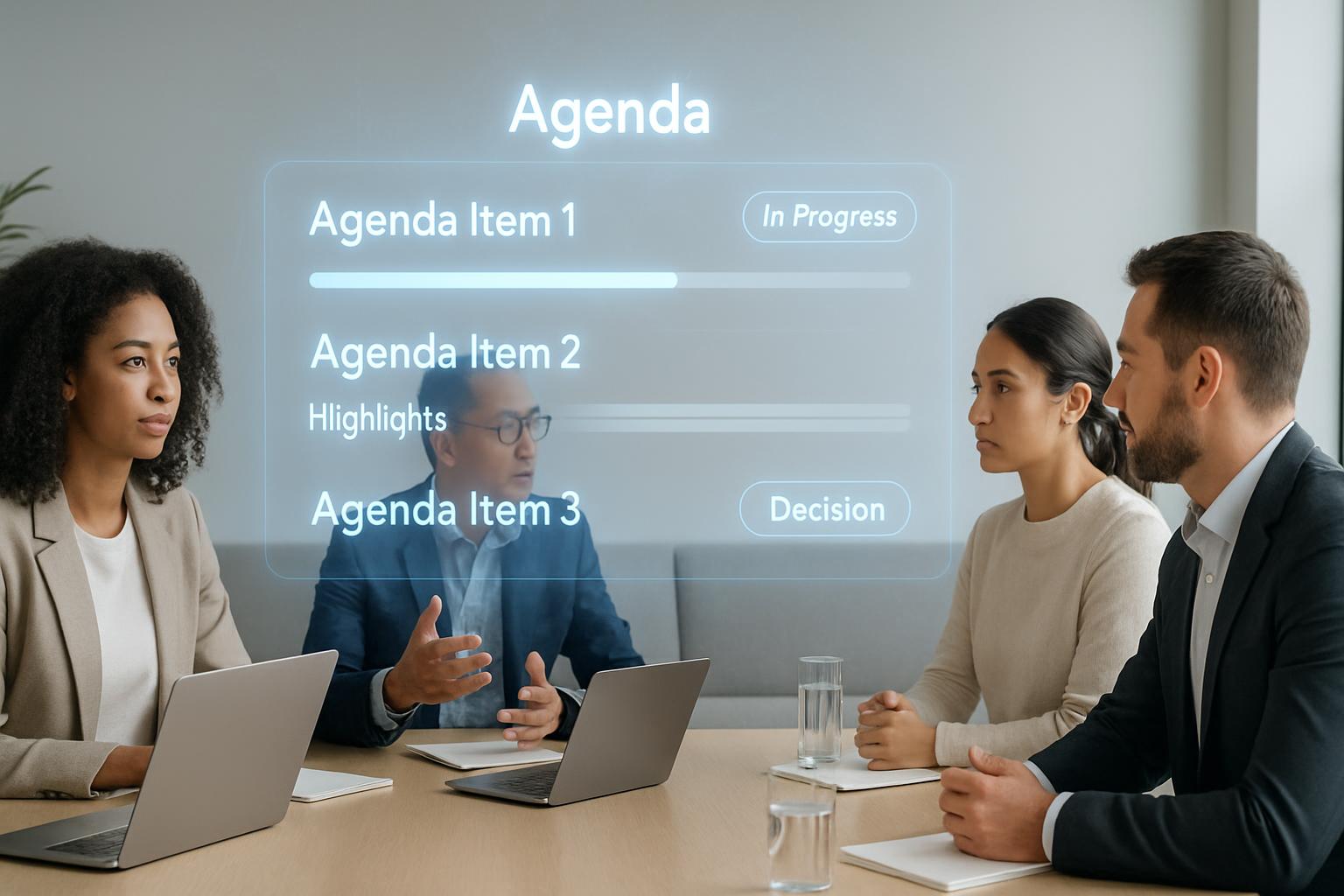
Real-time agenda rewriters use generative AI to adapt meeting flow, priorities, and expected outcomes while discussions unfold, improving alignment and reducing wasted time. Organizations that deploy adaptive meeting AI report up to 20-30% faster decision cycles and higher action-item completion rates when combined with clear governance and human oversight (industry pilot data).*
Introduction
Business meetings are expensive: time is money, and static agendas often fail to reflect the evolving priorities surfaced during a discussion. Generative AI-driven "Real-Time Agenda Rewriter: Using Generative AI to Adjust Meeting Flow, Priorities, and Outcomes While Discussions Unfold" offers a practical solution for business professionals seeking to keep meetings focused, equitable, and outcome-oriented. This article explains the concept, how it works, implementation guidance, governance considerations, and measurable KPIs to evaluate success.
Quick Answer: A real-time agenda rewriter listens to meeting dialogue, summarizes progress, reorders agenda items, updates priorities, and suggests desired outcomes in real time—helping teams pivot without losing context or accountability.
What is a real-time agenda rewriter?
A real-time agenda rewriter is a system that leverages generative AI, natural language processing (NLP), and meeting telemetry to dynamically modify an agenda as a meeting progresses. It identifies shifts in discussion, emergent priorities, and time pressure, then proposes adjustments—such as reprioritizing topics, extending or truncating items, or flagging new action items—to the meeting facilitator or participants.
How it works
The core workflow typically follows these steps:
- Ingest meeting audio, chat, and shared artifacts (slides, documents).
- Transcribe and perform real-time semantic analysis to detect topic changes, sentiment, and decision signals.
- Compare live discussion with the planned agenda and organizational priorities.
- Generate recommended adjustments (e.g., reorder, extend, or defer items) and suggested outcomes or deciders.
- Present recommendations unobtrusively to the facilitator (or automatically adjust agenda in low-risk scenarios).
- Log changes and rationales for auditability and post-meeting follow-up.
Core technologies
- Automatic Speech Recognition (ASR) for accurate real-time transcription.
- Natural Language Understanding (NLU) to detect intents, decisions, and emerging priorities.
- Generative models (GPT-style) to craft concise agenda updates, summaries, and suggested outcomes.
- Meeting telemetry integration (calendar, task systems, collaboration platforms) for context.
- Human-in-the-loop interfaces for facilitator control and override.
Why businesses need real-time agenda rewriting
Static agendas assume linearity. In reality, meetings are dynamic: new information, shifting priorities, stakeholder availability, and time constraints frequently alter the best path forward. Real-time agenda rewriting addresses three common pain points:
- Inefficient time use when discussions dwell too long on low-priority items.
- Lost context when new action items or risks emerge mid-meeting.
- Unequal participation where dominant voices steer the agenda away from planned outcomes.
Quick Answer: By continuously aligning meeting flow with real-time signals, organizations can improve decision velocity, raise meeting ROI, and ensure that outcomes reflect current priorities.
Implementing real-time agenda rewriting in meetings: process and best practices
Successful implementation balances automation with human judgment. Follow a phased approach with clear controls and measurable objectives.
Pre-meeting setup
-
Define objectives and success criteria: specify what better means (faster decisions, fewer follow-ups, better alignment).
-
Integrate data sources: calendar metadata, participant roles, prior meeting notes, and relevant documents.
-
Configure privacy and consent flows: obtain participant permissions for transcription and AI assistance.
-
Train models with domain-specific prompts and vocabulary to reduce hallucination and improve relevance.
During the meeting: real-time adjustment workflow
- Passive monitoring: the system transcribes and analyzes speech without taking action.
- Recommendation generation: when the AI detects a deviation or opportunity, it generates concise suggestions (reorder, time adjustment, or outcome proposal).
- Facilitator review: present recommendations in a lightweight UI (sidebar, producer console, or chat) for approval or modification.
- Execute and log: once approved, the agenda is updated and visible to participants; changes are timestamped and rationale recorded.
- Fallbacks: provide easy override and rollback controls to maintain human authority and trust.
Key UI elements should include unobtrusive alerts, suggested phrasing for reassigning time, and quick voting mechanisms when consensus is needed.
Post-meeting: action capture and learning loop
- Automatically capture decisions, owners, deadlines, and rationale; populate task systems.
- Provide a concise meeting brief that highlights deviations from the original agenda and reasons for changes.
- Collect facilitator feedback to improve recommendation precision and tune model prompts.
Governance, privacy, and security considerations
Introducing generative AI into live meetings raises governance and compliance questions. Prioritize policies that protect data and sustain trust.
Data handling
- Define retention policies for transcriptions, generated content, and logs.
- Encrypt audio and transcripts in transit and at rest; restrict access by role.
- Minimize data sent to third-party model providers; where possible, use on-prem or private-cloud inference for sensitive meetings.
Compliance and auditability
- Maintain an auditable trail showing why an agenda was altered and who approved changes.
- Ensure compliance with industry regulations (e.g., GDPR, HIPAA) by supporting data subject requests and anonymization workflows where necessary.
- Document model behavior, prompt templates, and testing results to support regulatory reviews.
Measuring impact: KPIs and metrics
Set measurable KPIs before deployment and track them continuously. Use a combination of quantitative and qualitative measures.
Recommended metrics
- Decision velocity: average time from agenda item start to decision vs. baseline.
- Action-item completion rate: percent of assigned tasks completed on time post-meeting.
- Agenda adherence delta: percentage of meetings where original agenda items were completed unchanged vs. adjusted (context matters).
- Meeting satisfaction score: participant-rated usefulness of agenda adjustments (survey).
- Facilitator override rate: frequency at which humans reject AI recommendations (indicator of model fit).
Practical use cases and example workflows
Real-time agenda rewriting is broadly applicable across functions. Examples include:
- Executive alignment meetings: dynamically surface strategic risks and reallocate time to emergent issues.
- Product standups: detect unplanned blockers and extend discussion for items with high impact.
- Customer escalation calls: prioritize high-severity topics as new information arrives and ensure action owners are clearly assigned.
- Board meetings: preserve formal decision records while allowing agenda shifts for urgent items with stakeholder sign-off.
Case vignette: A mid-sized SaaS company piloted a real-time agenda rewriter in product triage meetings and reported a 25% reduction in follow-up tickets and a 15% improvement in sprint throughput within three months (internal pilot).
Key Takeaways
- Real-time agenda rewriters use generative AI to adapt meeting flow, priorities, and intended outcomes while discussions unfold.
- They improve decision velocity, align meeting time with emergent priorities, and capture context for better follow-up.
- Successful deployments require facilitator control, clear governance, and privacy safeguards.
- Measure impact with a mix of operational KPIs (decision velocity, action completion) and human metrics (meeting satisfaction, override rate).
- Start small with pilot programs, iterate on prompts, and keep humans in the loop to build trust and accuracy.
Frequently Asked Questions
How does a real-time agenda rewriter avoid interrupting the natural flow of conversation?
Design principles prioritize unobtrusive suggestions: present recommendations to the facilitator via a secondary interface rather than surfacing them to all participants. Use concise, one-line suggestions and require facilitator approval to change the main agenda. This human-in-the-loop approach prevents undue interruption while still enabling adaptive control.
Can the system be trusted to make automated changes without human approval?
Trust depends on risk tolerance. For low-risk meetings or routine standups, organizations may allow predefined automatic adjustments (e.g., reallocate time between backlog items). For strategic or compliance-sensitive meetings, require facilitator approval. Monitor facilitator override rates and adjust automation thresholds over time.
How accurate are AI-generated agenda updates and summaries?
Accuracy varies with model quality, domain tuning, and ASR performance. Accuracy improves when models are trained on organization-specific language and when high-quality audio is available. Implement validation: show suggested edits and allow fast corrections. Continuous learning from facilitator feedback also reduces error rates.
What are the privacy implications of transcribing meetings in real time?
Real-time transcription creates sensitive data. Mitigate privacy risks by requiring explicit consent, encrypting data, limiting retention, and providing clear policies for data access. For regulated environments, prefer on-premises or private-cloud deployments and anonymization where practical.
Which stakeholders should be involved when implementing this technology?
Key stakeholders include meeting facilitators, IT/security teams, legal/compliance, HR (for policy and training), and representative end users. Engage them early to define acceptable automation levels, data policies, and change management plans.
What does a typical rollout timeline look like?
A conservative phased rollout spans 8–16 weeks: 2–4 weeks for requirements and integrations, 3–6 weeks for pilot deployment and tuning, and 3–6 weeks for broader rollout including training and governance checks. Timelines vary with integration complexity and regulatory needs.
Where can I learn more about best practices and research?
Start with vendor whitepapers, industry analyst reports, and academic research on meeting intelligence and human-AI collaboration. For industry context and adoption statistics, see analyst reports such as Gartner and McKinsey, and follow published case studies from early adopters. For example, McKinsey’s work on AI in collaboration offers strategic guidance on enabling technologies and organizational readiness (see McKinsey & Company, 2023).*
*Pilot and industry statistics referenced are indicative and should be validated against organizational data. For vendor selection and regulatory advice, consult your internal compliance and legal teams.
Sources: McKinsey & Company, "How AI can improve collaboration", 2023; industry pilot reports from productivity platform vendors. (External sources may provide additional case studies and technical guidance.)
Scheduler
Hand your calendar to an assistant that never drops a thread.
Keep reading

Where Do All Your Meetings Actually Go? The Real Cost, By the Numbers
Reclaim.ai surveyed 1,300+ professionals on how much time meetings eat, what they cost, and how often they fall apart before they even happen. The numbers are more specific than the usual complaint.
![Three-Question Compact Agendas: Proven System [Pro]](https://nuxxt0us9k7umi1n.public.blob.vercel-storage.com/blog-covers/6a0e45ff6996f1fff37fb29f_article-27586b25-d86a-4410-9f05-1e27213c92c4.jpeg)
Three-Question Compact Agendas: Proven System [Pro]
Eliminate delays with Three-Question Compact Agendas: Schedule short internal syncs that start on time and end with decisions. Read the analysis now
![Subset-Critical Windows: Proven Scheduling [Expert Guide]](https://nuxxt0us9k7umi1n.public.blob.vercel-storage.com/blog-covers/6a0e4602d4e4fcd05af4bfe9_article-2cf1d83b-25fb-41d7-b3ca-af2248d7d1b7.jpeg)
Subset-Critical Windows: Proven Scheduling [Expert Guide]
Act now: Master Subset-Critical Windows scheduling to speed decisions when only a small, key group must attend a multi-party meeting. Read analysis.