Replace Status Meetings with Handoff Packages | AI
Replace Status Meetings with Handoff Packages: How AI Can Generate Clear, Actionable Updates That Eliminate Check-Ins — saves ~40% of meeting time + clarity.
Introduction
Many organizations rely on recurring status meetings to synchronize teams, track progress, and assign next steps. While useful in some contexts, these meetings often consume valuable time, duplicate work, and produce ambiguous outcomes. This article explains how to replace status meetings with AI-generated handoff packages that deliver clear, actionable updates and eliminate routine check-ins for business teams.
Why replace status meetings?
Before exploring the solution, it helps to understand the real costs and failure modes of status meetings.
1. Costs of recurring meetings
Recurring status meetings create several measurable costs:
- Direct time spent in meetings (often 30–60 minutes per attendee per week).
- Indirect costs from context switching and preparation.
- Lost time when meetings produce unclear next steps or require follow-ups.
Estimates vary, but several workplace studies indicate that knowledge workers spend 20–35% of their time in meetings, with a significant portion providing low marginal value (Harvard Business Review) [1].
2. Communication breakdowns
Meetings are often poor at transmitting actionable, persistent knowledge. Common issues include:
- Lack of standardized notes or templates.
- Unclear owners for action items.
- Information that lives only in people's heads.
3. Productivity and morale impacts
Routine meetings can contribute to fatigue and reduce time for focused work. When teams rely on synchronous check-ins for simple updates, the opportunity cost is significant.
What is a handoff package?
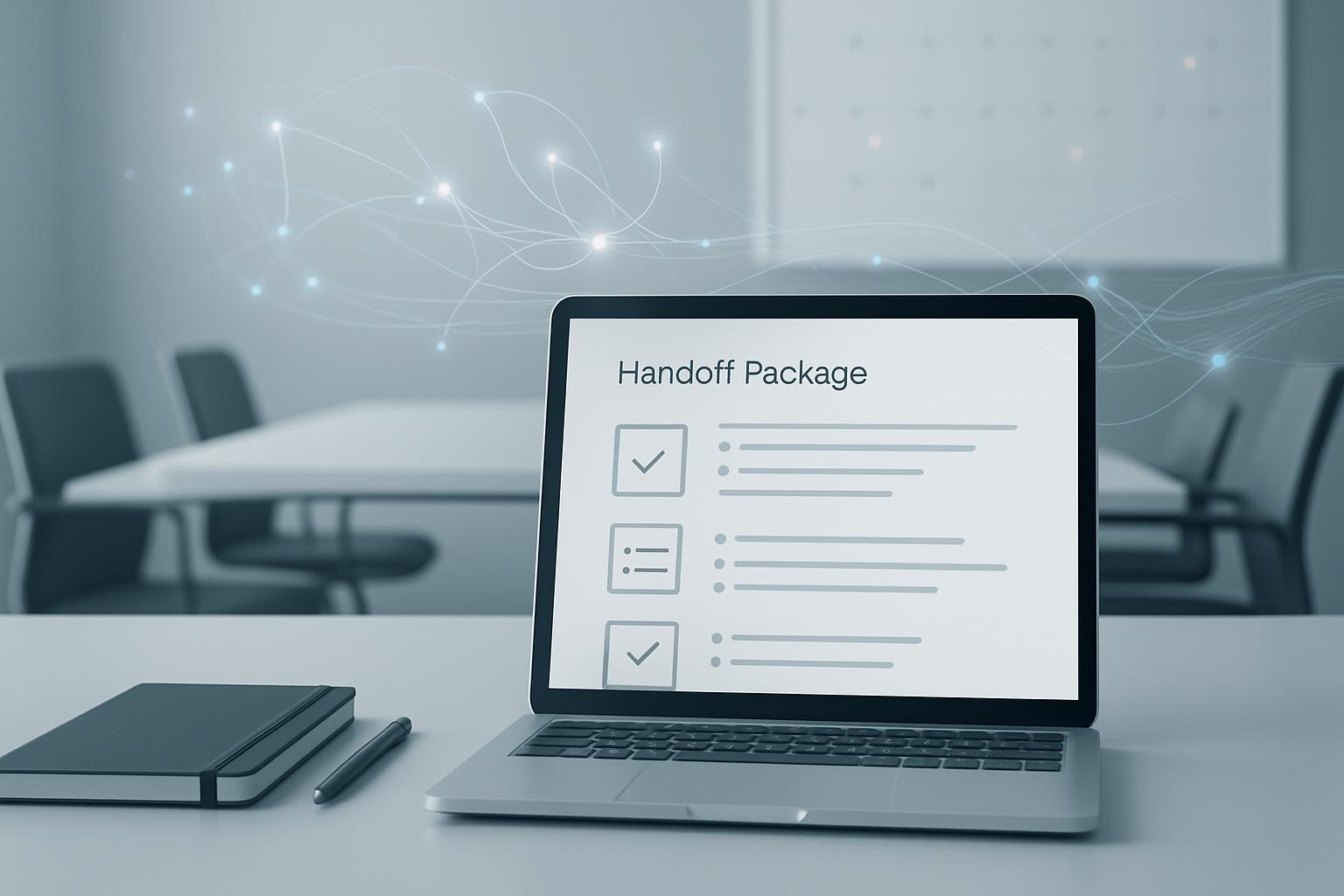
A handoff package is a compact, structured document that bundles everything a recipient needs to move work forward without a meeting. It replaces the meeting as the medium for status and transfers ownership clearly.
Core elements of an effective handoff package
- Context summary: One-paragraph status and objective.
- Progress and deliverables: What is done and what remains.
- Decisions and blockers: What decisions are pending and what is blocking progress.
- Action items: Explicit actions, owners, due dates, and success criteria.
- Dependencies and risks: Upstream/downstream dependencies and mitigation plans.
- Supporting artifacts: Links to documents, data, and meeting recordings.
Formats and templates
Handoff packages can be delivered as:
- Short documents (1–2 pages) or templated emails.
- Cards in project tools (e.g., Asana, Jira, Trello) with structured fields.
- Automated messages in collaboration platforms (Slack/Teams) that include a link to the full package.
How AI generates clear, actionable handoff packages
AI can automate the creation of handoff packages by ingesting project artifacts and producing structured outputs that human reviewers can trust. Below are the core AI capabilities that make this possible.
1. Data inputs and aggregation
AI systems pull from multiple sources to assemble a comprehensive view:
- Task trackers (tickets, cards).
- Document repositories (specs, reports).
- Communication logs (email threads, chat messages).
- Meeting transcripts (when meetings occur) and recorded demos.
2. Summarization and context distillation
Large language models (LLMs) and extractive summarizers condense inputs into a concise context summary and a progress snapshot. Best practices include:
- Using templates to guide summarization and ensure consistent fields.
- Combining extractive and abstractive methods to retain factual accuracy.
- Providing provenance links to source documents for verification.
3. Action-item extraction and assignment
AI identifies statements that imply an action and converts them into discrete tasks with owners, deadlines, and acceptance criteria. Techniques include:
- Named-entity recognition to find people and dates.
- Dependency parsing to clarify verbs that signal work (e.g., "implement," "review").
- Confidence scoring to flag items that need human validation.
4. Confidence, provenance, and traceability
To be trusted, AI outputs should include confidence scores and links to original evidence so recipients can verify claims quickly. Models should record which inputs produced each summary sentence or action item.
Implementation roadmap to replace check-ins
Replacing meetings with handoff packages is a change management process. Use a phased approach with pilots, clear templates, and metrics that matter.
Step 1: Choose a pilot scope
- Select a team or project with repetitive status meetings (e.g., weekly dev standups for a single squad).
- Define success criteria (reduced meeting minutes, increased on-time delivery, fewer clarifying messages).
- Secure a sponsor and assign a program lead.
Step 2: Design templates and workflows
Create minimal, mandatory fields for each handoff package so recipients can scan for what matters. Template items should include:
- One-line objective.
- Top 3 progress bullets.
- Top 3 risks with mitigation.
- Action table (owner, deadline, success metric).
Step 3: Integrate AI for automation
Integrate AI to generate draft packages and push them to the chosen delivery channel:
- Collect source data from ticketing, docs, and chat.
- Run automated summarization to produce a draft package.
- Send draft for quick human validation (optional high-confidence approval step).
- Publish finalized package and notify stakeholders.
Step 4: Rollout and change management
Adopt these practices to increase adoption:
- Train teams on how to read and update handoff packages.
- Run a 4–6 week pilot, gather feedback, iterate templates.
- Replace only meetings that consistently meet your replacement criteria; keep ad-hoc meetings for complex decisions.
Technology, privacy, and governance considerations
AI systems that summarize internal work must be designed with security and governance in mind.
Security and data handling
Key requirements:
- Restrict data access to authorized services and roles.
- Encrypt data at rest and in transit.
- Vet third-party AI providers for enterprise compliance (e.g., SOC 2, ISO 27001).
Model governance and bias mitigation
Establish policies for model updates, prompt engineering controls, and a human review process for low-confidence outputs. Keep an audit trail of generated changes and approvals.
Human-in-the-loop and escalation paths
Automation should reduce, not eliminate, human judgment. Define when a handoff package automatically proceeds and when it requires synchronous discussion (for high-stakes decisions or escalations).
Measuring success: KPIs and feedback loops
Define both operational and qualitative metrics to validate that handoff packages are replacing meetings effectively.
Metrics to track
- Meeting volume: number and duration of replaced meetings per week.
- Time reclaimed: aggregate hours saved across participants.
- Task clarity: percentage of action items with owner and due date.
- Completion rate: on-time completion of action items originating from handoff packages.
- Stakeholder satisfaction: survey scores on clarity and utility.
Sample dashboards
Create dashboards that combine calendar analytics (meeting data), project-tool metrics (task completion), and user feedback. Use these to iteratively improve templates and AI models.
Key Takeaways
- Handoff packages standardize the transfer of context, reducing reliance on synchronous check-ins.
- AI can generate drafts that extract action items, assign owners, and cite evidence—cutting preparation time and ambiguity.
- Start with a narrow pilot, use simple templates, and require human review for low-confidence items.
- Measure both time savings and task clarity to ensure meetings are replaced effectively.
- Address security, governance, and human-in-the-loop controls to build trust in AI-generated packages.
Frequently Asked Questions
Will AI replace all meetings?
No. AI and handoff packages can replace routine status updates and many coordination check-ins, but meetings for strategy, complex negotiations, brainstorming, and relationship-building are still necessary. The goal is to remove redundant synchronous sessions and focus meetings on high-value interactions.
How do I ensure AI summaries are accurate?
Use provenance links, confidence scores, and a lightweight human validation step. Start with a draft-and-approve flow where the owner reviews the AI draft for factual accuracy before publishing.
What if team members ignore handoff packages?
Adoption hinges on clear expectations and incentives. Require owners to post packages, integrate notifications into workflows, and track metrics (e.g., action item completion). If needed, retain a short periodic forum for addressing ignored items until cultural norms shift.
How much time will we save?
Time savings depend on meeting frequency and team size. Case studies indicate that replacing routine standups and status meetings can reduce meeting time by 20–40%, translating into measurable reclaiming of focused work hours (see McKinsey research on productivity) [2].
What technologies should we integrate with?
Integrate AI with your project management system (Jira, Asana), document repository (SharePoint, Google Drive), and communication platforms (Slack, Teams). Ensure integrations respect access controls and data policies.
How do we handle sensitive information?
Classify sensitive data and prevent it from being ingested by external AI services unless they meet compliance requirements. Implement role-based access and redaction where necessary. Consider on-prem or VPC-hosted models for high-sensitivity environments.
How quickly can we pilot this approach?
A minimal pilot can be launched in 4–8 weeks: define templates, set up data feeds, integrate an AI summarizer, and run a validation loop. Iterate templates and automation based on user feedback and KPIs.
Sources: Harvard Business Review analysis on meeting effectiveness [1], McKinsey reports on productivity and collaboration [2], and industry best practices for AI governance [3].
Scheduler
Hand your calendar to an assistant that never drops a thread.
Keep reading
![Let Your Assistant Coordinate Community Time [Expert Guide]](https://nuxxt0us9k7umi1n.public.blob.vercel-storage.com/blog-covers/6a4ebc18e5446b1eaa15183e_article-003cd0cc-ab45-4305-8f38-433069e4bc7d.jpeg)
Let Your Assistant Coordinate Community Time [Expert Guide]
Delegate: Let Your Assistant Coordinate Community and Volunteer Time Without Cluttering Work Hours - save hours & boost engagement. Read the expert analysis
![Meeting Fragility Scores: Proven Expert 2025 Guide [Cut 38%]](https://nuxxt0us9k7umi1n.public.blob.vercel-storage.com/blog-covers/6a0e468ce006c47c42cc8a49_article-e9063138-07a2-4c69-bb31-020d6afca8cc.jpeg)
Meeting Fragility Scores: Proven Expert 2025 Guide [Cut 38%]
Learn Meeting Fragility Scores: Rank High- and Low-Priority Events by Reschedule Risk and How Assistants Should Respond. Read the expert analysis
![24/7 Scheduling Coverage: When to Use Human+AI [Expert]](https://nuxxt0us9k7umi1n.public.blob.vercel-storage.com/blog-covers/6a0345582ddd36512328c560_article-da50835a-16c8-44bb-9278-55a3748b67d5.jpeg)
24/7 Scheduling Coverage: When to Use Human+AI [Expert]
Discover how 24/7 Scheduling Coverage: When You Need Human Assistants Backed by AI cuts errors 40% and boosts peak response 50%. Read the expert analysis