What the Data Says About Why Your Work Calendar Feels Broken
The average knowledge worker loses 103 hours a year to unnecessary meetings, and half of all meetings land right in the middle of peak focus hours, per Asana and Microsoft's own research. Here's what the data says is actually breaking calendars, and where AI agents can help.
Your Calendar Isn't Imagining It
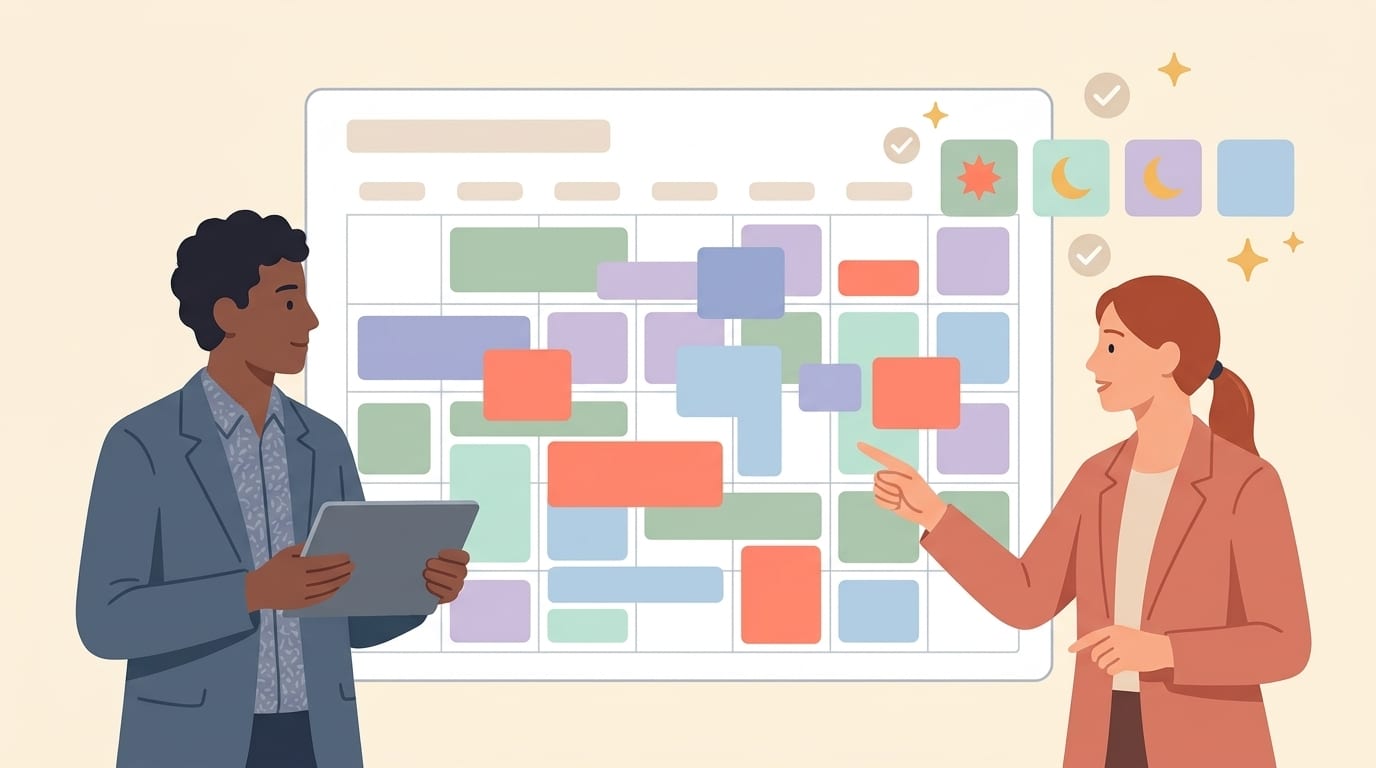
If your workday feels like it's run by other people's meetings, the data backs that feeling up with real numbers. Microsoft's "Breaking Down the Infinite Workday" report, a June 2025 follow-up to its Work Trend Index built on trillions of anonymized Microsoft 365 productivity signals, found that half of all meetings, exactly 50 percent, take place between 9 to 11 a.m. and 1 to 3 p.m., precisely the windows when most people hit their natural circadian productivity peak. Tuesdays carry the heaviest meeting load at 23 percent, while employees using Microsoft 365 are interrupted on average every two minutes by a meeting, email, or notification during core work hours.
That sprawl isn't cosmetic. Microsoft's own global Work Trend Index survey found 48 percent of employees, and 52 percent of leaders, say their work feels chaotic and fragmented. And it's getting more, not less, tangled: 57 percent of meetings are now ad hoc calls with no calendar invite at all, one in ten scheduled meetings gets booked at the last minute, and nearly a third of meetings now span multiple time zones, up 35 percent since 2021.
The Time Cost, Counted in Hours Per Year
Microsoft's telemetry shows the shape of the chaos; Asana's Anatomy of Work Index, a global survey of over 10,000 knowledge workers, puts a number on what it costs. The average knowledge worker spends 60 percent of their time on "work about work": chasing updates, coordinating logistics, and switching between tools, rather than on the skilled work they were actually hired to do. Broken down over a year, that adds up to 103 hours lost to unnecessary meetings, 209 hours on duplicative work, and 352 hours simply talking about work rather than doing it.
The knock-on effects show up in Asana's data too: 88 percent of knowledge workers say time-sensitive projects or large initiatives have fallen behind or fallen through the cracks because of the sheer volume of tasks competing for their time, and responding to constant emails, unexpected meetings, and chasing approvals are the top three reasons people report staying late.
It's Not Just Meetings, It's the Coordination Around Them
Miro's 2025 Momentum at Work Report, which surveyed over 6,100 knowledge workers globally, frames the same problem from a different angle: for every one hour of momentum work (the creative, strategic work that actually moves a project forward), knowledge workers spend three hours on maintenance work, meetings, email, and paperwork. Sixty-two percent say that maintenance load slows them down and reduces their productivity, and 39 percent specifically point to a failure to fully use AI as a reason maintenance work keeps piling up.
That last figure matters, because the same report found knowledge workers are already fairly optimistic about the fix: 55 percent agree AI can help with administrative tasks, and 46 percent believe it can specifically reduce the load of meeting follow-up.
Where AI Agents Actually Help, and Where They Don't
The data points to a specific, fixable slice of the problem. AI agents aren't going to make a genuinely necessary strategy meeting disappear, that's momentum work, in Miro's framing, and it's supposed to take real time. What the numbers above describe as broken is almost entirely maintenance and coordination: finding a time that works across time zones, chasing down whether a meeting actually needs to happen, re-summarizing what was decided for someone who couldn't attend, and re-booking the ad hoc calls that Microsoft's data shows now make up 57 percent of all meetings. That's exactly the kind of well-defined, repeatable coordination work an agent can take off a calendar without touching the actual decision-making inside the meeting itself.
Sign up for our newsletter
Get the latest updates, product launches, and helpful tips delivered straight to your inbox.
Where a Platform Like Workmate Fits In
The gap Miro's report surfaces, 55 percent of workers believe AI can help with admin tasks, but most teams haven't actually built that into their workflow yet, is precisely the space a connected agent platform like Workmate is meant to close. A scheduling or coordination agent needs to reach into a team's actual calendar, email, and meeting tools rather than operate as a standalone app, which is why Workmate is built around 3,000-plus integrations with admin-level control over exactly which systems an agent can touch. An admin can scope a scheduling agent to read and propose calendar changes without handing it broader access, and Workmate's credential vault can require a human's approval before it acts on a booking or cancellation, so the coordination overhead gets absorbed without losing visibility into who agreed to what.
What This Means for Anyone Staring at a Full Calendar
The numbers converge on the same conclusion from three independent sources: the problem isn't that people are bad at managing time, it's that the coordination layer around modern work, ad hoc meetings, cross-time-zone scheduling, chasing approvals, has grown faster than anyone's calendar was designed to handle. Teams that specifically target that coordination layer with AI, rather than trying to will their way through more meetings with better discipline, are the ones most likely to actually claw back the 103 hours a year Asana's data says the average knowledge worker is currently losing.
Frequently Asked Questions
How much time do knowledge workers actually lose to bad scheduling? Asana's Anatomy of Work Index puts it at 103 hours a year to unnecessary meetings alone, plus 209 hours to duplicative work and 352 hours talking about work rather than doing it, out of a total 60 percent of time spent on "work about work."
Why do meetings feel like they're always at the worst time? Because they often are. Microsoft's Work Trend Index data shows 50 percent of all meetings land in the 9-11 a.m. and 1-3 p.m. windows, the same hours most people hit their natural circadian productivity peak.
Can AI agents actually fix meeting overload? Not the meetings that genuinely need to happen, but the coordination around them, finding times, rebooking ad hoc calls, chasing approvals, is exactly the repeatable work Miro's research shows workers already expect AI to help with (55 percent for admin tasks, 46 percent for meeting follow-up).
Sign up for our newsletter
Get the latest updates, product launches, and helpful tips delivered straight to your inbox.
Scheduler
Hand your calendar to an assistant that never drops a thread.
Keep reading
![Personal CRM for Busy Professionals — Proven [Expert Guide]](https://nuxxt0us9k7umi1n.public.blob.vercel-storage.com/blog-covers/6a4ebc1bc9f0db5df88f43d4_article-4c713aac-f045-433e-a0f9-fa40d8d41b92.jpeg)
Personal CRM for Busy Professionals — Proven [Expert Guide]
Discover Personal CRM for Busy Professionals: Use Basic AI to Remember Names, Promises, and Follow‑Ups Without Extra Effort — Get the full breakdown
Paper-to-Calendar Made Easy: How to Capture Notes, Sticky Ca
Learn about Paper‑to‑Calendar Made Easy: Capture Notes, Sticky Cards and Voice Memos and Turn Them into Calendar Actions Using Basic AI Tools in this comprehensive SEO guide.
![Skill Sprint Scheduler: Proven AI for 15‑Min Growth [Expert]](https://nuxxt0us9k7umi1n.public.blob.vercel-storage.com/blog-covers/69fc9ff2e6b4b9f970278548_article-d9efcc50-467e-4a06-9871-f1cc6709d88f.jpeg)
Skill Sprint Scheduler: Proven AI for 15‑Min Growth [Expert]
Reserve 15 minutes daily — Skill Sprint Scheduler: Use Simple AI to Protect 15‑Minute Daily Practice Blocks for Career Growth. Read the expert analysis