AI Notetakers Are Sitting In on More Meetings Than You Think, Often Without Asking
One in three employed Americans say an AI notetaker has been in their work meetings, and 65% of them say they weren't consistently asked first, according to a July 2026 survey. Here's what that consent gap actually means for teams and legal risk.
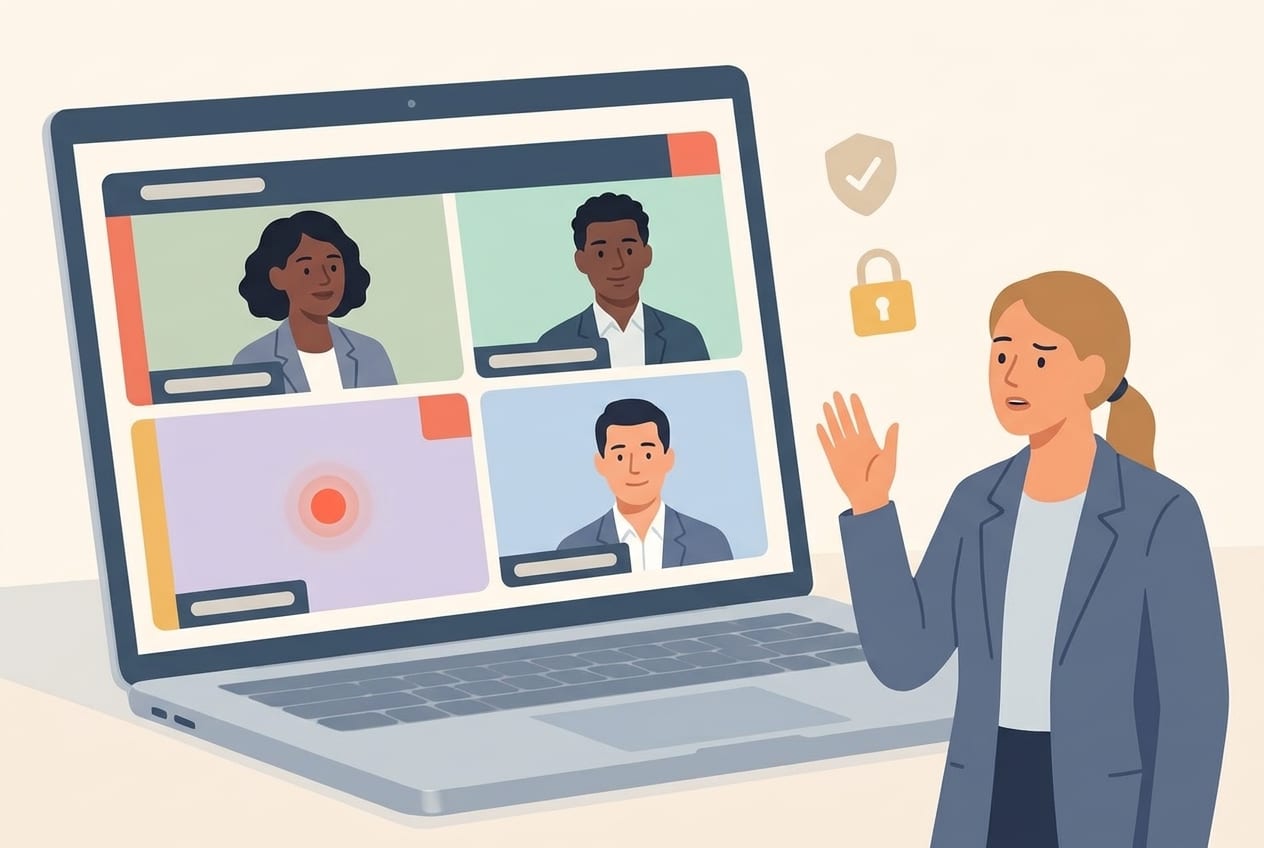
The AI Notetaker Has Quietly Become a Coworker
Somewhere in the last two years, an AI notetaker started sitting in on a third of American work meetings, and most people never got asked if that was okay. A July 2026 survey of 500 employed U.S. adults, commissioned by Kolmogorov Law and run through the Pollfish research platform, found that 33.4 percent of employed Americans say an AI notetaker or transcription bot, tools like Otter.ai, Fireflies, Zoom AI Companion, or Microsoft Copilot, has been present in their work meetings. Another 22.4 percent said they simply don't know whether they've been recorded, which is arguably the more revealing number.
Recording First, Asking Later
Among the 167 surveyed workers who had experienced an AI notetaker in a meeting, only 34.7 percent said they were always asked for permission before it recorded or transcribed. Everyone else fell somewhere on a spectrum of inconsistent or absent consent: 36.5 percent were asked only sometimes, 25.1 percent said the bot simply appeared with no request at all, and 3.6 percent found out about the recording only after the fact. Add those up and 65.3 percent of workers who've encountered an AI notetaker say consent was inconsistent or missing entirely.
The problem isn't limited to AI tools specifically. Nearly one in five workers overall (18.8 percent) say they've discovered after the fact that a meeting or call was recorded or transcribed without their knowledge, and 8 percent say it's happened to them more than once.
This isn't a hypothetical legal question anymore, either. A federal class action against Otter.ai alleges the company's tool recorded and transcribed meetings without the consent of all participants, in violation of California's two-party consent wiretapping law. Otter.ai has denied the allegations and the case is still pending, but it's the clearest sign yet that the consent gap the survey measured has moved from an office annoyance into active litigation.
Most Workers Don't Know the Rules Exist
The knowledge gap compounds the consent gap. Several states, including California, legally require every participant's consent before a conversation can be recorded, but the Kolmogorov Law survey found only 35 percent of workers already knew that. Nearly 42 percent (41.8 percent) said they had no idea recording laws applied to work meetings at all, and another 11.6 percent incorrectly believed one participant's consent was enough everywhere. In short, roughly two-thirds of the American workforce doesn't understand the legal baseline that determines whether the AI notetaker in their last meeting was even operating lawfully.
That ignorance doesn't mean indifference once people imagine it happening to them, though. Asked what they'd do on discovering that a company had repeatedly recorded their meetings without consent, 29.2 percent said they'd complain to the company or HR, and a combined 29 percent said they'd either speak with a lawyer (19 percent) or join a class action if one existed (10 percent). For an employer, that's a meaningful share of the workforce describing a silent recording as a lawyer-up event, not a shrug-it-off one.
What This Means for Any Team Running AI Notetakers
The survey's own framing is the practical takeaway: assume nobody on the call has consented until they've actually been asked. That's a low bar operationally, most meeting tools have a built-in way to announce a recording bot or ask for a thumbs-up before it joins, but the data shows plenty of teams are skipping it anyway, whether out of habit or because the tool auto-joins by default. Given that a single compliance failure repeated across many recorded meetings can compound into real statutory exposure in two-party consent states, a written policy that says when notetakers are used and how consent gets captured is cheap insurance against a problem the survey shows is already common and already in court.
Sign up for our newsletter
Get the latest updates, product launches, and helpful tips delivered straight to your inbox.
Where a Platform Like Workmate Fits In
The Kolmogorov Law data points at a specific failure mode: notetaker bots that operate on their own default settings, auto-joining calls with no visibility into who approved them or what happens to the transcript afterward. That's the opposite of how Workmate is built to handle any agent that touches sensitive interactions like meetings. Access to connected meeting and calendar tools is set by an admin, not left to a tool's own defaults, and Workmate's credential vault can require a human's explicit approval before an agent takes an action, which is exactly the kind of checkpoint that would have caught the 65.3 percent consent gap the survey found. Workmate is also SOC 2 Type II audited and Google CASA verified, relevant for any company treating meeting transcripts as the sensitive records they legally are.
What This Means for Teams Going Forward
AI notetakers aren't going away, adoption is climbing precisely because they save real time on meeting documentation. But the survey is a clear signal that the industry has moved faster on adoption than on consent, and that gap is now showing up in courtrooms, not just compliance memos. Teams that treat "who consented, and how do we know" as a solved problem rather than an assumption are the ones least likely to end up as the next data point in a survey like this one.
Frequently Asked Questions
How common are AI notetakers in work meetings? About a third of employed Americans (33.4 percent) say an AI notetaker or transcription bot has been present in their meetings, according to the July 2026 Kolmogorov Law survey of 500 employed U.S. adults.
Are companies asking for consent before using AI notetakers? Not consistently. Among workers who've encountered an AI notetaker, only 34.7 percent say they were always asked for permission first; 65.3 percent describe consent as inconsistent or absent altogether.
Is recording a meeting without consent actually illegal? It can be, depending on the state. Several states, including California, require all-party consent before a conversation is recorded. A pending federal class action against Otter.ai alleges exactly this kind of violation, though the company denies the allegations and the case hasn't been resolved.
Sign up for our newsletter
Get the latest updates, product launches, and helpful tips delivered straight to your inbox.
Scheduler
Hand your calendar to an assistant that never drops a thread.
Keep reading
![Privacy‑Safe Personal Appointments: Expert Guide [Proven]](https://nuxxt0us9k7umi1n.public.blob.vercel-storage.com/blog-covers/6a4ebc1188d93a9e734f50e2_article-28df6357-c673-43f7-8598-4df42e844f3e.jpeg)
Privacy‑Safe Personal Appointments: Expert Guide [Proven]
Enable Privacy‑Safe Personal Appointments: Let an Assistant Book Health or Family Slots Without Revealing Details —Proven controls. Read expert analysis
Scaling Accurate Speaker Attribution with Hybrid Human + ML
Learn about Speaker Attribution at Scale: Hybrid Human+ML Workflows to Ensure Accurate Transcript Speaker Labels in this comprehensive SEO guide.

Measuring the Business Impact of Recorded Meetings: KPIs for
Learn about KPIs for Recorded Meetings: Measuring Impact on Deal Velocity, Onboarding Speed, and Decision Quality in this comprehensive SEO guide.